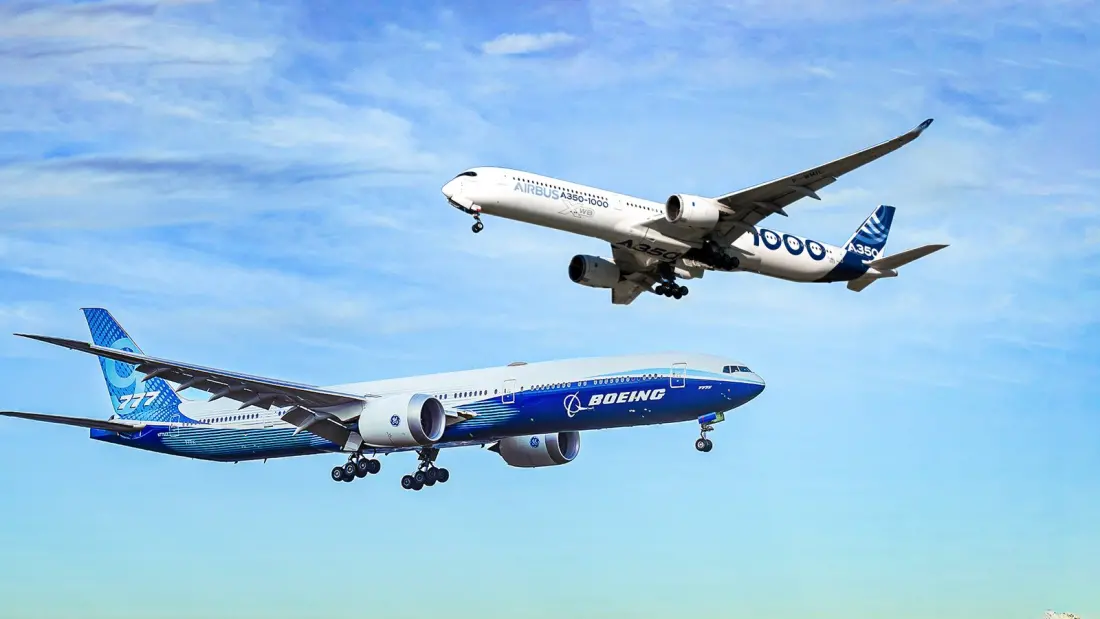
The four-engine era is winding down, and two aircraft now share the job of connecting the world's farthest-flung hubs: Airbus's A350-1000 and Boeing's 777-9. Both are huge twin-engine widebodies built for ultra-long-haul flying, but they were designed with very different ideas about how to do it — and for passengers, those differences show up in cabin comfort, routes and even when you'll actually get to fly on one.
Airbus went all-in on composites. Roughly 70% of the A350-1000 is advanced material, including carbon-fibre reinforced polymer fuselage barrels, which cut weight and fatigue issues. For travellers, the payoff is a cabin pressurised to a lower equivalent altitude with higher humidity — you arrive feeling less wrecked. Boeing took a hybrid route for the 777-9: a familiar aluminium fuselage paired with an all-new carbon-composite wing borrowed thinking from the 787. It's heavier, but let Boeing reuse its Everett production lines.
The engines are a study in contrast. The 777-9's exclusive GE9X is the largest commercial jet engine ever built — a 134-inch fan wider than a 737's fuselage — producing 105,000 lbf of thrust. The A350-1000 sticks with Rolls-Royce's Trent XWB-97, at 97,000 lbf with a 118-inch fan, achieving excellent efficiency in a more compact package. Both burn double-digit percentages less fuel than older widebodies.
Then there's timing. The A350-1000 entered service with Qatar Airways in February 2018, giving Airbus years of operational experience. The 777-9 has slipped from a 2020 target to 2027, meaning Airbus will have had the ultra-large twinjet market to itself for nearly a decade by the time Boeing's jet carries passengers.
Capacity and range split the two strategically. The 777-9's 5.97-metre cabin fits ten-abreast economy seating and around 426 passengers in two classes, making it a volume machine for dense hub-to-hub trunk routes — Emirates and Qatar Airways plan exactly that. The A350-1000, slightly narrower, typically flies nine-abreast with 350-410 seats and suits airlines filling secondary long-haul routes. Its range is the standout: 9,100 nautical miles, which is why Qantas chose a modified A350-1000 for Project Sunrise, the nonstop Sydney–London and Sydney–New York services. The 777-9's quoted baseline is around 8,000 nautical miles.
The 777-9's party trick is its folding wingtips — a first in commercial aviation. Unfolded, its 71.8-metre wingspan would push it into Code F gate territory like the A380; on the ground, the outer 3.5 metres of each wingtip folds upward, shrinking it to fit standard Code E gates. It also happens to be the longest passenger jet ever built at 76.7 metres, about ten feet longer than the A350-1000.
Why should a traveller care? If you're booked on a long-haul route in the next few years, you'll almost certainly be on an A350-1000 — and its composite cabin is genuinely nicer for 16-hour flights. The 777-9's extra space promises roomier premium cabins on mega-hub routes once it finally arrives in 2027. Aviation geeks planning a flight just to try a new aircraft type should book the Airbus first.