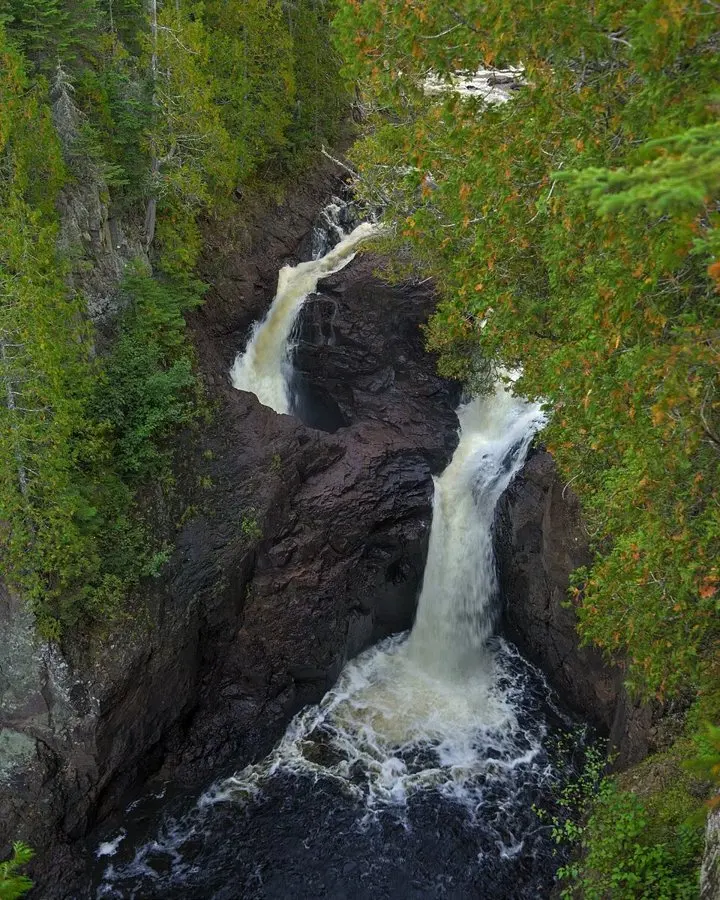
On Minnesota's North Shore, the Brule River hits a fork in the rock and does something no river should: it splits in two. One half drops over a 15-metre waterfall and carries on downstream. The other pours straight into a dark hole in billion-year-old rhyolite and appears to disappear entirely.
This is Devil's Kettle, inside Judge C.R. Magney State Park about 23 kilometres northeast of Grand Marais. For years it was a genuine puzzle. Locals wondered if the water was finding its way to Lake Superior through hidden passages, and the objects people tossed into the pothole over the decades never resurfaced. So the legends grew.
Then in 2016, hydrologists from the Minnesota Department of Natural Resources settled it with a flow meter instead of folklore. They measured the river above the falls at about 123 cubic feet per second, and below at roughly 121 — essentially identical once you allow for measurement error. Nothing was vanishing. The water swallowing itself into the kettle was quietly rejoining the Brule downstream. As for the lost frisbees and the rest, the plunge pool's churning currents simply trap and recirculate whatever goes in rather than flushing it onward.
None of which spoils the visit. Reaching the falls is a proper little hike: the Devil's Kettle Trail runs about 1.6 kilometres one way along the river through birch, spruce and cedar, ending with a descent of roughly 175 stairs. The DNR suggests budgeting 1.5 to 2 hours for the round trip, and the terrain is rocky and uneven, so wear real walking shoes rather than treating it as a quick photo stop.
It slots neatly into a Highway 61 North Shore road trip, and hikers can extend the day — the park links up with the Superior Hiking Trail. If you want to linger, there are 27 drive-in campsites plus a seasonal campground, and shorter trails along the Brule for a slower look at the forest.
Practicalities: you'll need a vehicle permit to enter the park, and it's worth leaving enough energy for the climb back up those stairs. Grand Marais makes a convenient base with food and lodging nearby.
The appeal here isn't mystery anymore — it's the strange pleasure of watching a river do something that looks impossible while knowing exactly how it works. That's a decent reason to take the detour.