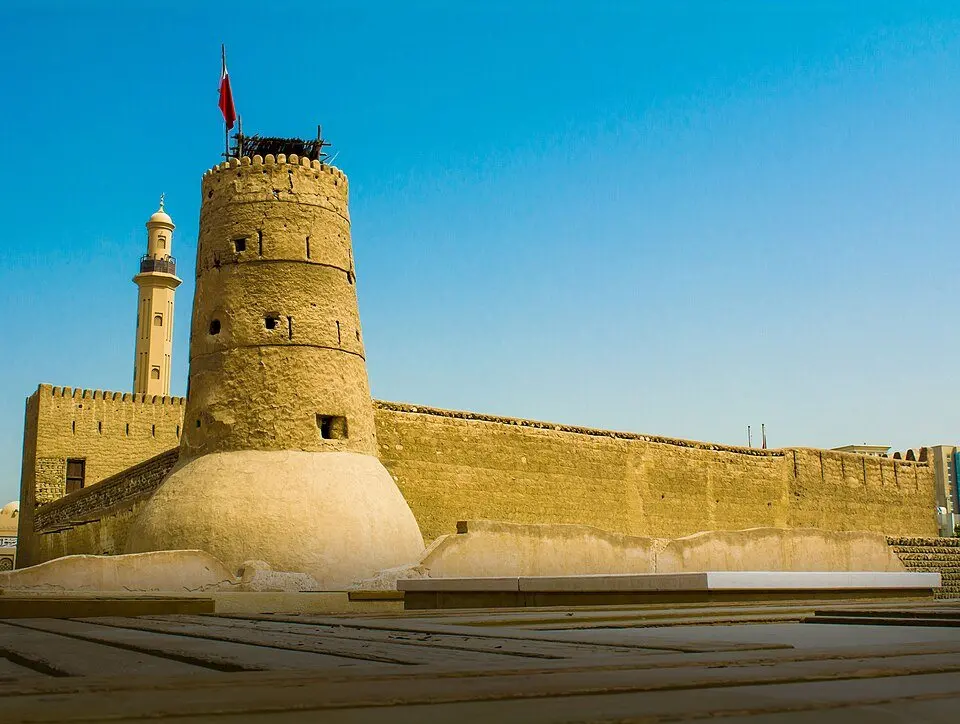
Long before Dubai had a skyline worth photographing, it had a fort. Al Fahidi Fort, built in 1787 and the city's oldest surviving structure, is preparing to welcome visitors again after five years of restoration work.
The fort sits in Old Dubai near Dubai Creek, in the historic Al Fahidi neighbourhood beside Al Seef, the waterfront strip with a recreated souk. That location tells the story in miniature: step from the reconstructed market, walk past the fort's coral-and-shell walls, and the glass towers of the modern city rise right behind. Before oil, the creek was the heart of local trade in fish and pearls; the fort was built in phases as a defensive stronghold, roughly 41 by 33 metres, with three corner towers and a single entrance behind a heavy teak door studded with iron nails and brass plates. Its thick walls kept out both attackers and the heat.
The building has worn many hats: ruler's residence, seat of government, prison, arsenal. In 1971, the year the UAE was founded, it became Dubai's first museum. Now it has been reimagined as one for the immersive age. A new underground extension opens the visit with galleries on defence, leadership and craftsmanship, using artefacts, archives and digital experiences. Inside the fort proper, The Vault is a light-and-sound show tracing Dubai's military history, while another gallery, A Landmark Across the Ages, follows the building's changing roles across nearly 240 years. There's a collection of Islamic arms and armour, plus interactive activities aimed at children, and the watchtowers, gates and courtyard are all open to explore. Ayisha Khansaheb, who directs the fort for the Dubai Culture & Arts Authority, frames it as a gateway to the city's past, telling Euronews Travel there's a growing need to show that Dubai has "a soul, a culture and a history".
The reopening also lands at a sensitive moment. The Iran war that began in February 2026 hit Dubai's tourism hard, with missile and drone attacks disrupting flights. Recovery is underway — hotel occupancy climbed from 36% in March to 66% in August, per the Dubai Department of Economy and Tourism — but international arrivals for the first eight months of 2026 stood at 6.97 million, well down on 12.24 million a year earlier. A flagship heritage attraction is part of the pitch to win travellers back.
For visitors, the fort makes a natural anchor for a day in Old Dubai: pair it with the Al Fahidi neighbourhood's wind-tower houses, a ride across the creek on an abra, and the spice and gold souks on the Deira side. It's the antidote to a mall-heavy itinerary, and a reminder that the world's most futuristic city started with coral walls and a teak door.