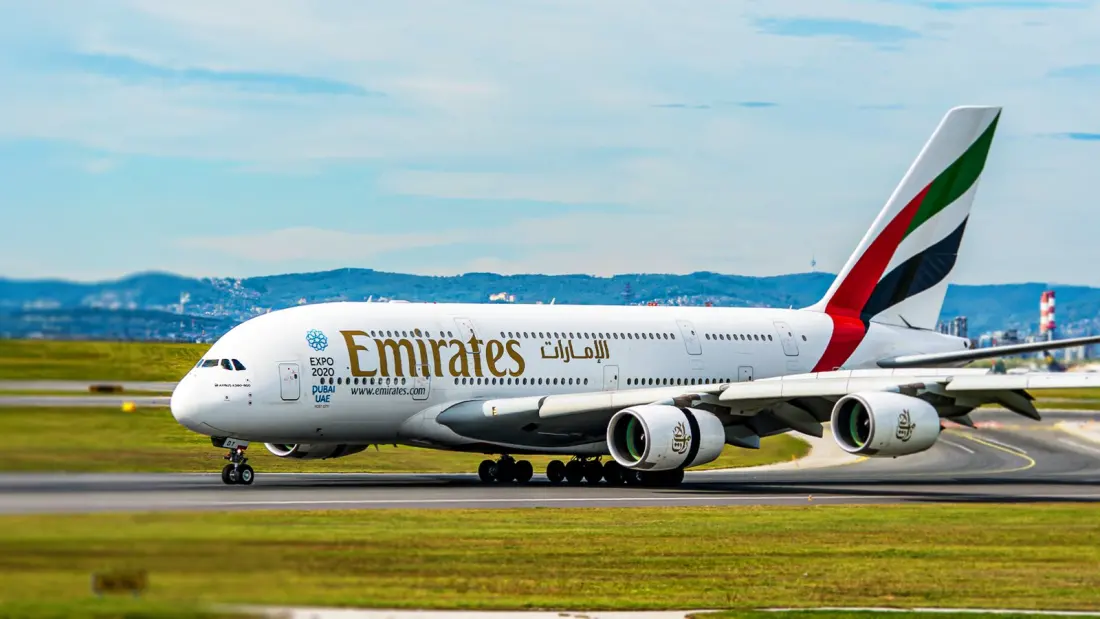
A decade ago, Emirates quietly dropped the Airbus A380 from its Dubai–Dallas/Fort Worth route, promising it would return by September. It never did. That 2016 episode now looks like a rehearsal for the airline's latest US changes: from late August and September, the superjumbo is off the Houston and Washington Dulles routes, replaced by Boeing 777s.
Houston (IAH) switches to the smaller 777-200LR, while Washington Dulles (IAD) moves to the 777-300ER. Both shifts appear permanent. Meanwhile, Emirates is also trimming frequencies elsewhere in the US — Boston drops from seven to six weekly flights with a 777 swap, Orlando cuts to four or five weekly, and Seattle dips to five weekly before partially recovering in October.
It's part of a much bigger reshuffle involving a dozen non-US routes too, including Singapore, Sydney, Munich, Bangkok and Rome, with some A380 services temporarily or indefinitely replaced by 777s. The pressure is coming from two directions: 27 of Emirates' 116 A380s are grounded — partly due to the ongoing Middle East conflict and softening demand for flights through the region — and the airline is midway through a heavy retrofit programme of its 15 high-capacity A380s, which have no first class and carry up to 615 seats. Those jets are being reconfigured to 569 seats, adding a 78-seat business cabin plus premium economy, with each conversion taking about 30 days. The full fleet should be done by the end of this year.
What does this mean if you're booked on one of these routes? The A380 is the passenger favourite for good reason: onboard showers for first class with heated floors, a walk-up cocktail bar on the upper deck shared with business class, and far more premium seats overall. Emirates' 2026 Houston A380 operation carries around 65,700 premium seats annually — the 777s flying to Dallas offer roughly half that at just over 35,000. Expect tighter availability in business and first, and some passengers nudged down a cabin.
The long-term picture is the incoming Boeing 777X. Emirates has 270 on order, and the 400–450-seat twinjet will become the airline's new flagship, better able to replace the A380 on premium-heavy routes than today's older 777s. Emirates even plans an unstaffed self-serve lounge for eight passengers between two business class sections — a nod to the A380 bar, if a smaller one.
For now, travellers on Houston and Washington should check which aircraft is on their date before locking in a premium fare, because the shower-and-bar experience is off the table on those routes. Frequent flyers holding A380 hopes for Dallas should remember how that story ended in 2016: the superjumbo was never regularly seen there again.