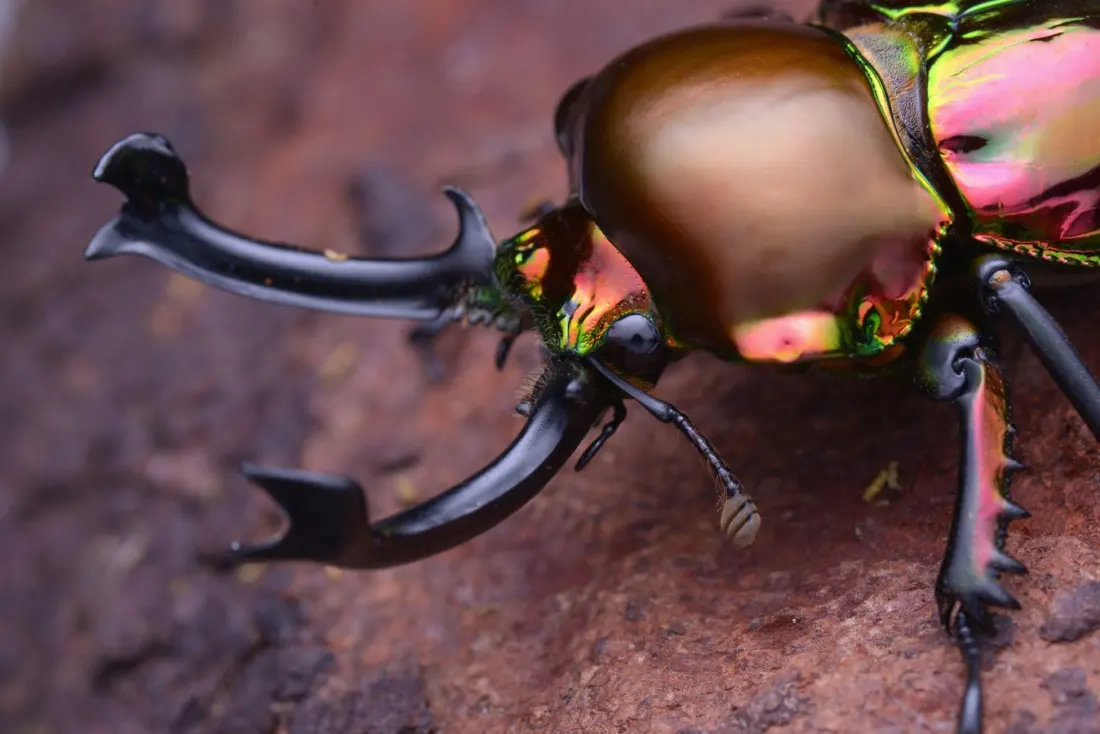
Deep in the rainforests of north Queensland's Wet Tropics lives an insect that looks like it was dipped in liquid metal. The rainbow stag beetle (Phalacrognathus muelleri) shifts through green, gold, copper, red and occasionally blue — and those colours come from microscopic structures in its shell that bend light, not from pigment at all. When entomologist Sir William John Macleay first described the species in 1885, he called it the most beautiful insect he had ever seen.
It's a claim that still holds up. Also known as the king stag beetle, it's the largest of Australia's nearly 100 stag beetle species. Males reach 24–70mm, females 23–46mm, and both sport the iridescent armour. The species also turns up in New Guinea, but Queensland's wet tropics are its Australian stronghold — one more reason this pocket of the country is a bucket-list region for nature lovers.
The beetle's life story is stranger than its looks. Most of it happens underground: larvae spend several years tunnelling through rotting logs and eating decaying wood, completely hidden from view. Then, almost overnight, adults emerge with a short window to find a mate. That pressure explains the males' oversized mandibles. They're heavy, awkward and costly to grow, which is precisely the point — only a strong male can afford them. Males wrestle on logs and branches near sap flows, using their jaws to lift and toss rivals off the perch, with mating rights going to the last beetle standing.
The colours remain a partial mystery. They may act as close-range signals to rivals or mates, or — somewhat ironically — as camouflage among the wet, light-dappled foliage of the rainforest. One thing is certain: the iridescence fades after death, so museum specimens never capture what a live beetle looks like in a shaft of sunlight. You have to see it in the wild, or at least in a well-kept vivarium, to appreciate it.
Why should a traveller care? The Wet Tropics — the stretch of rainforest from around Townsville to Cape York, taking in Daintree, Kuranda and the Atherton Tablelands — is one of the oldest continuously surviving rainforests on Earth, and its invertebrate oddities are as compelling as its cassowaries and tree kangaroos. Night walks and guided rainforest tours in the region regularly turn up spectacular beetles, and the rainbow stag beetle is the prize sighting. It's also hugely popular with insect hobbyists overseas, with captive-bred beetles commanding serious money among collectors — a reminder of how remarkable the wildlife on your doorstep can be when you visit Queensland.
For anyone drawn to the weird end of natural history, this beetle is a good excuse to slow down in the Daintree rather than rushing between lookouts. Bring a torch, book a guide who knows the logs worth checking, and look closely at fallen wood — that's where the next generation is quietly growing.
Story via Australian Geographic.