
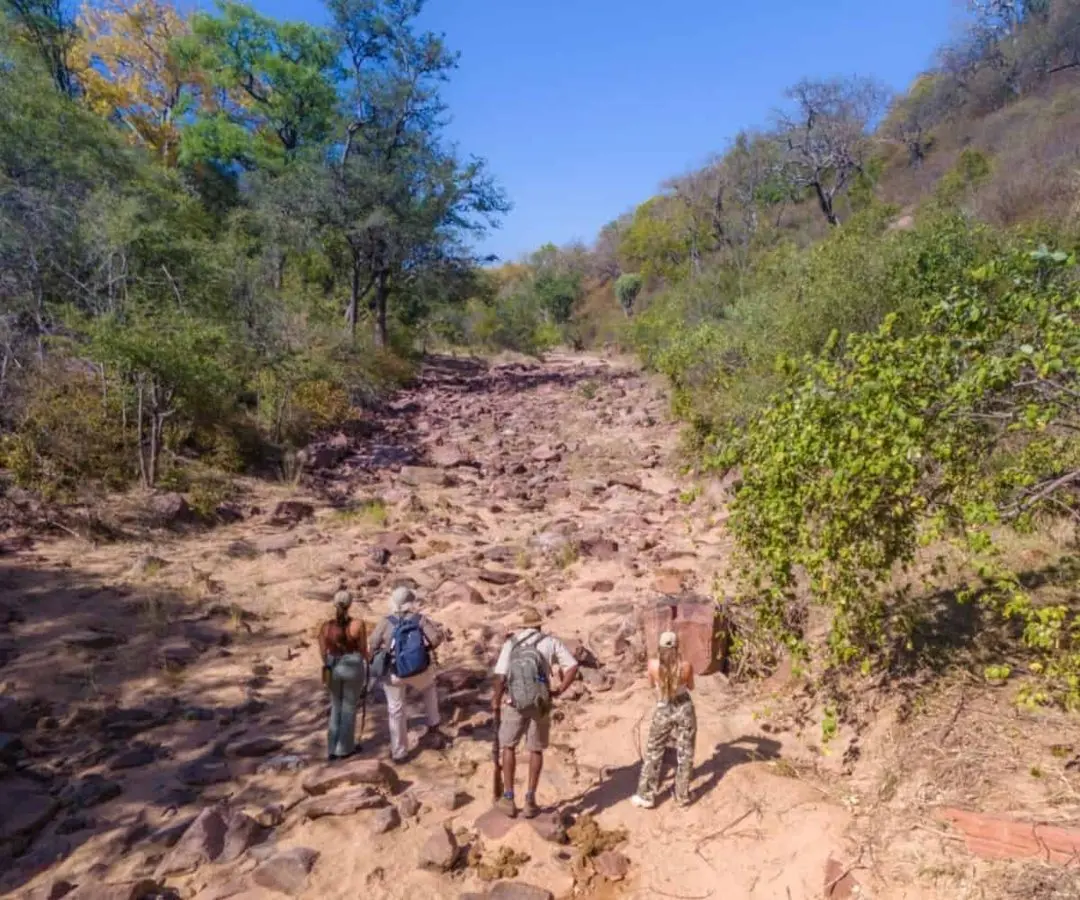
Zimbabwe's best walking routes weren't carved by park rangers or waymarked with painted blazes. They're elephant paths, dried riverbeds and generations-old game trails — and following them on foot is the entire point of the safari.
That's the pitch behind Zimbabwe's walking safari tradition, which has quietly built a reputation as some of the finest bush walking in Africa. While neighbouring Zambia is credited with inventing the modern walking safari, Zimbabwe has taken a different route: here, walking isn't an add-on to a game drive itinerary. It replaces it.
There's usually no marked trail at all. Each day's route depends on fresh spoor, wind direction, where a breeding herd of elephants is drinking, or an alarm call drifting through the trees. Guides read the bush as they go — tracks in the sand, a broken branch, an overturned stone all become part of the story.
The reason Zimbabwe pulls this off comes down to people, not wildlife numbers. The country's Professional Guide qualification is considered among the toughest on the continent, taking years and thousands of hours of training in ecology, tracking, animal behaviour, bushcraft, astronomy and wilderness safety before a guide can lead guests on foot in dangerous game country. The result: guides who can identify a bird from a single call or spot leopard tracks before anyone else has looked down.
Northern Hwange National Park is the flagship for this style of travel. Unlike the flat Kalahari sands of the park's south, the north has sandstone hills, natural springs, hidden gorges and the Deka River — varied terrain that suits slow, self-propelled travel. Walkers move through shifting habitats along the river, from open woodland to rocky escarpments and permanent springs.
The experience goes beyond wildlife, too. The region holds ancient Nambya settlements, San hunter-gatherer petroglyphs and petrified forests — evidence of people reading this landscape for thousands of years. Ecology, geology and human history all fold into the same walk.
Much of the walking happens inside private concessions, which means no queues of safari vehicles at sightings and no fixed schedule. Guides can linger at a spring where elephants are drinking or change course entirely based on what the bush offers that morning.
By the end of a multi-day walk, most travellers stop scanning for animals and start looking for the clues they leave behind. That shift in how you see the bush, rather than any single sighting, is what makes these trips memorable.
For active travellers who've already done a standard game-drive safari and want something slower and more immersive — or hikers curious about Africa beyond mountain trails — Zimbabwe's walking safaris are a strong fit for a 2026 trip. Expect to come home with a new set of eyes.