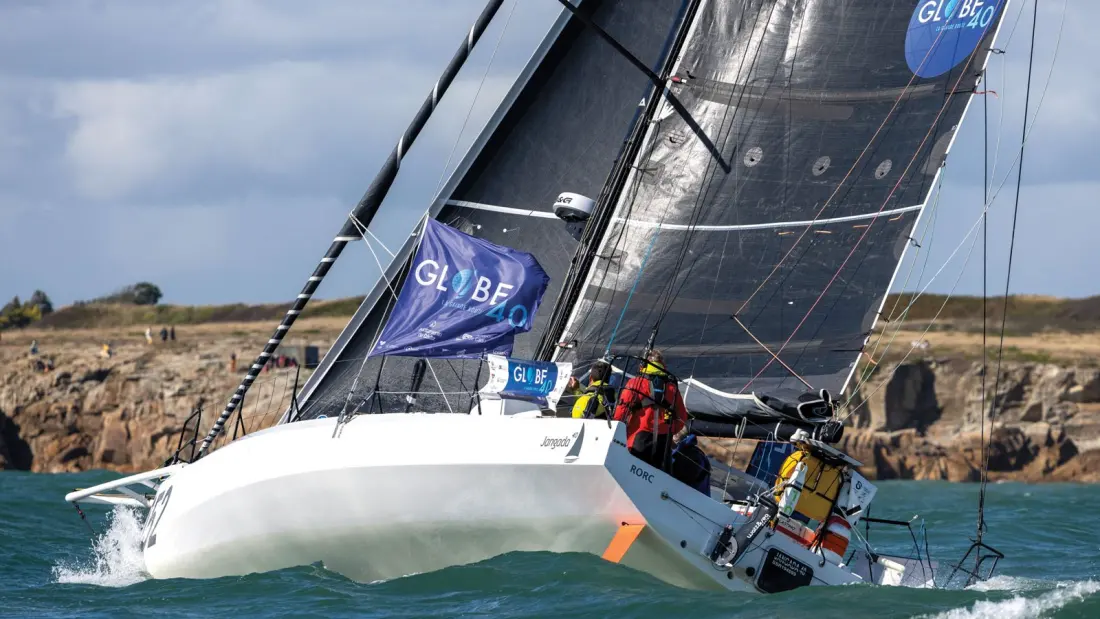
Racing around the world double-handed is about the harshest equipment test you can run. Rupert Holmes of Yachting World completed the Globe40 race aboard the Class 40 Jangada 40, covering more than 34,000 miles via the Great Capes with minimal stopovers, and his verdict on the big-ticket systems — water, power, comms, steering — is gold for anyone fitting out an offshore yacht.
Connectivity was the headline story. Starlink changed how the crew managed safety and daily life at sea, but the Gen3 flat dish drew 6-8A at 12V (13A on startup), so it was switched on a few times a day rather than left running, matched to a 50Gb monthly plan. Deep in the Southern Ocean, connections took 15-20 minutes and sometimes two attempts. Teams with Starlink Minis struggled more — by Sydney, every boat that had started with a portable unit had moved to a permanent transom mount. Starlink handles no voice calls, so a satellite phone remained mandatory: an Iridium 9555 with a second unit in the grab bag, plus an Iridium Certus 200 (192kbps data) as backup against Starlink's changeable terms.
AIS choices matter more than most people realise. The Emtrak B953 Class B+ transmitter puts out 5W instead of the standard Class B 2W, pushing detection range from 6-8 miles to 16-18. That proved decisive: ships altered course for them around 12 miles off, well beyond the reach of standard units. Radar earned its keep too — the B&G Halo24 tracked night squalls reliably and picked up unlit 8-10m wooden fishing boats at about 0.75 miles, though the interface is clunky and MARPA target tracking is unintuitive.
The Katadyn PowerSurvivor 40E watermaker delivered a steady 5 litres per hour at just 4-5A on 12V, and worked flawlessly once installed — the catch being the intake position, which sucked in air bubbles above 3-4 knots until they replumbed it. An underrated hero was the Offshore Tec keel camera: over the race the boat snagged a 20m polypropylene line, heavy hawsers, fishing net, plastic sheeting, Patagonian kelp and 1,800 miles of sargassum. Seeing the obstruction live from the helm turned a slow recovery job into a quick head-to-wind manoeuvre. Note the first camera unit failed between Sydney and Valparaiso due to imperfect waterproofing.
The autopilot setup was the most redundant: a B&G H5000 with two serviced Raymarine linear rams on separate data buses, each with its own pilot computer, tied together by the Pixel sur Mer Exocet overlay. The Exocet's ability to steer to heel angle — bearing away in gusts, heading up in lulls — kept them fast and upright while others broached. It never needed the backup in anger.
For sailors planning a bluewater cruise or rally, the takeaways are practical: spec Class B+ AIS, plan watermaker intake placement for speed, budget seriously for Starlink power draw, keep an independent satphone, and don't underestimate a keel camera.