
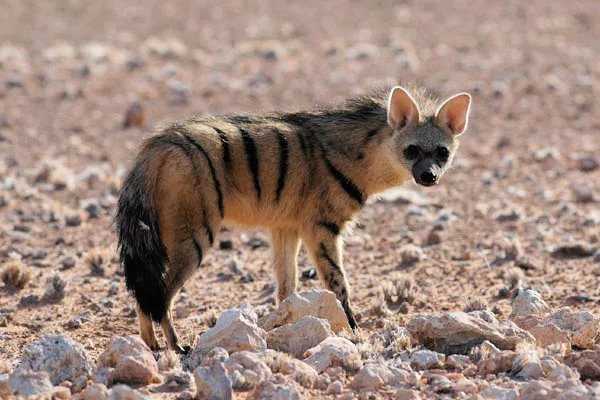
Not every African predator needs to be fierce. The aardwolf looks like a small, striped hyena, and genetically that's exactly what it is — but its entire lifestyle runs counter to everything the hyena family is known for. Instead of chasing prey or scavenging carcasses, Proteles cristata spends its nights licking up termites with a long, sticky tongue, sometimes eating thousands in a single night.
That diet has reshaped the animal from the inside out. Its cheek teeth are much reduced compared with those of spotted and brown hyenas, because crushing bone or tearing meat simply isn't on the menu. Strong front claws handle the digging, a mane runs along its neck and back, and a striped coat helps it disappear into grassland and shrub. Crucially, it doesn't wipe out termite colonies — it feeds lightly and moves on, keeping its food supply sustainable.
That extreme specialisation is why conservationists care. Termites underpin grassland and savanna ecosystems: their colonies shape soil structure and nutrient cycling, and they feed birds, reptiles and mammals up the chain. The aardwolf sits right on top of that termite economy, so anything that degrades grasslands — agricultural expansion, habitat fragmentation, or changes to the frequency and intensity of fire and grazing — ripples straight through to it. In South Africa the species is found in areas including the Free State, Eastern Cape and Northern Cape, making it an unexpected barometer for the health of these heavily modified landscapes.
For travellers, the aardwolf offers a compelling alternative to the Big Five checklist. It's predominantly nocturnal, so seeing one means patience, a spotlight and a fair amount of luck. The best bets are Kgalagadi Transfrontier Park, Mountain Zebra National Park, Karoo National Park and Mokala National Park, along with private reserves in suitable grassland and savanna habitat. Conditions and access vary, so it's worth contacting reserves ahead of a trip to ask about recent sightings and night drives.
There's a quiet thrill to it, too: after dark on an open plain, scanning the grass for a slender, striped shape doing exactly what evolution built it to do. Spotting one is a genuine badge of honour for wildlife watchers — and a reminder that Africa's most interesting predator stories aren't always the loudest ones.