
Chilean expedition operator Antarctica21 has published its first Sustainability Report, a document called "Ambassadors of the White Continent" that lays out how the company measured its environmental, social and economic footprint across its 2025-26 fiscal year. It's not just PR fluff, either — the report follows the GRI Universal Standards 2021 and covers 104 indicators under a sustainability roadmap that runs to 2033, the company's 30th anniversary.
The headline numbers are worth knowing if you're considering one of their Antarctica fly-cruise trips. Total emissions came in at 6,878 tonnes of CO2 equivalent, measured across Scopes 1, 2 and 3, and the company says it offset the lot with certified credits linked to renewable energy projects in Chile. On the water, it ran a second straight season powering its Zodiac landing craft with e-fuels — it claims to be the world's first operator to use synthetic fuel in Antarctica.
On land, the solar panels at Explorers House, the company's expedition centre in Punta Arenas, supplied 44 percent of the building's energy. Locally, 25.4 percent of supplier spending stayed within Chile's Magallanes Region, and the Antarctica21 Foundation reached 4,000 direct beneficiaries during the season.
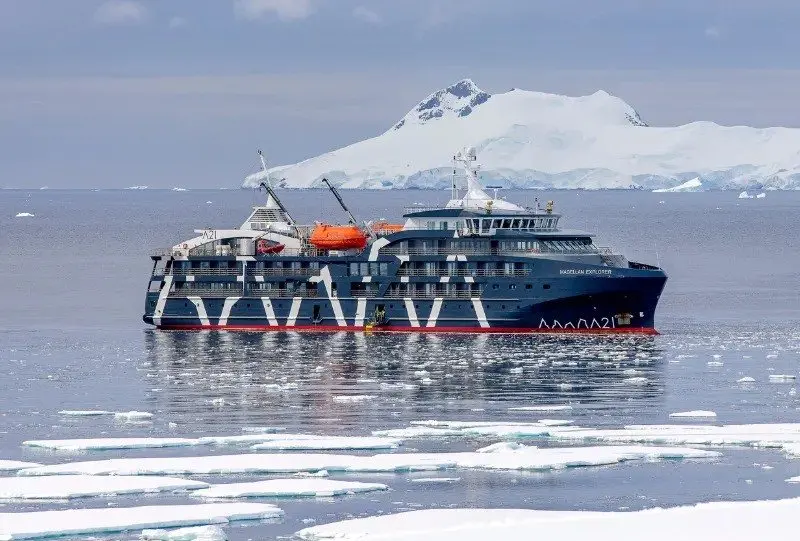
The bigger news for future travellers is a ship. The Magellan Explorer — described as the first hybrid-electric polar cruise ship in the Americas — is more than 90 percent complete at the ASENAV shipyard in Valdivia. In April 2026 it completed its first autonomous navigation on the Calle-Calle River, its first time moving under its own power, ahead of sea trials. A sister vessel, the Discoverer, is due for delivery on September 30 with an inaugural voyage set for December 15.
Why does this matter to travellers? Antarctica trips are expensive and high-impact, and more operators are now publishing hard data rather than vague green promises. If you're weighing up expedition companies, a report like this gives you something concrete to compare — emissions accounting, fuel choices, local spending — before you commit several thousand dollars. It also signals where the industry is heading: hybrid-electric propulsion and synthetic fuels are likely to become selling points, not novelties.
For anyone booked with Antarctica21 in the coming seasons, the practical takeaway is that you'll increasingly be sailing on newer, lower-emission ships out of Punta Arenas — the gateway city most of its air-cruises depart from, letting travellers skip the rough Drake Passage crossing by flying to the Antarctic peninsula instead.