
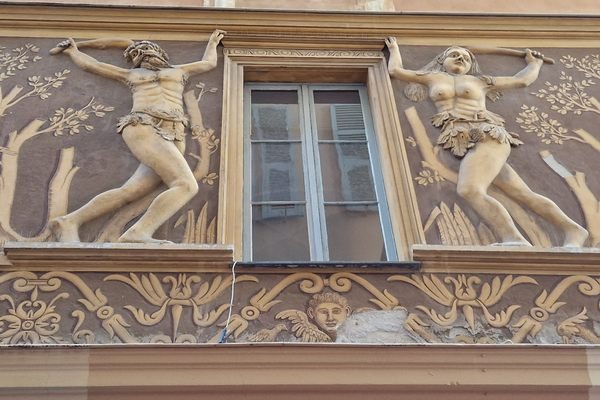
Tucked into Nice's old town at 8 rue Poissonnerie stands one of the city's rarest survivors: a house whose façade has been decorated since 1584. Known as the Adam and Eve House, it's one of the last painted houses of that era still visible in Nice, which makes it a small but genuine treasure for anyone wandering the narrow streets between the Cours Saleya market and the sea.
What makes the façade special is the technique behind it. The decoration was done in sgraffito, a method that flourished in Italy during the 15th and 16th centuries. Craftsmen applied multiple layers of plaster tinted in contrasting colours to a moistened surface, then cut or scratched through the top layer to reveal the colours beneath. The result looks almost carved — which is why the figures on this house appear to be in bas-relief even though the wall is essentially flat.
The name comes from what the scene seems to show: some say it depicts Adam and Eve in the Garden of Eden. But Nice has a cheekier interpretation. Local legend claims the figures are actually the fiery-tempered couple who lived in the house when it was decorated — an eternal portrait of a domestic argument rather than a biblical scene. There's no way to settle the debate, and honestly, that ambiguity is part of the charm. Stand in front of it for a minute and decide for yourself.
For travellers, the appeal is twofold. First, it's free and effortless to see — the house sits in the densest, most atmospheric part of Vieux Nice, so you'll likely pass it while hunting for socca, wandering the flower market, or drifting toward the Promenade des Anglais. Second, it's a reminder that the Riviera's famous resort city has a much older, messier, more Italian history beneath the beach-club veneer. Nice only became French in 1860, and its old town still reads more like Genoa than Paris — this façade is exactly that heritage made visible.
A quick tip: the façade is best appreciated in the morning, when the rue Poissonnerie front catches the light and the streets haven't yet filled with lunch crowds. Pair it with a slow loop of the old town's painted and sculpted façades — several other buildings nearby carry decorative detail from different centuries — then climb Castle Hill for the view over the terracotta roofs you've just been walking beneath.
It won't take more than ten minutes of your day, but the Adam and Eve House is the kind of detail that turns a beach holiday into a story worth telling. Whoever those quarrelling figures really are, they've been mid-argument for over 400 years — and they're showing no signs of stopping.
Story via Atlas Obscura.