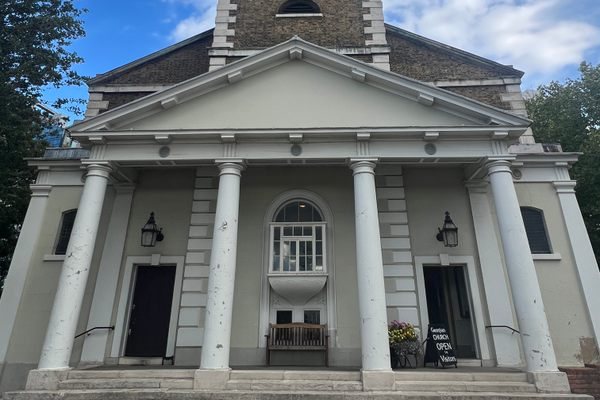
America's most famous traitor is buried in an unassuming spot on the south bank of the Thames. St. Mary's Church in Battersea, London, holds the grave of Benedict Arnold, the Revolutionary War general who tried to hand West Point over to the British, along with his wife Peggy Shippen Arnold, who moved to London with him after the plot collapsed.
There's a certain irony in the arrangement. Arnold rests in a crypt that now doubles as a community space — a modest eternity compared with his fellow conspirator John André, the British officer executed in the same affair, who lies in grand style in the nave of Westminster Abbey. Upstairs, a stained glass window installed in the 1970s pays Arnold an unexpectedly warm tribute, a nod to the decades of argument over what actually drove his betrayal.
Arnold isn't the only famous name tied to the church. Poet William Blake married his wife Catherine here in 1782, and there's a modern window honouring him. Painter J.M.W. Turner, who grew up nearby, is remembered with glass of his own — he reportedly painted many of his Thames riverscapes from the vestry. Botanist William Curtis, who gathered plant specimens from the churchyard, completes the set.
The building itself has history to spare. A church has stood on the site since around 800 AD; the current one, designed by Edward Hollis-era architect? No — by the surveyor of Greenwich? Actually the present structure was completed in 1777, close enough to the Arnold era that he would have known it.
For travellers, it's a free, working Anglican church that's easy to slot into a walk along the river. Battersea sits between Chelsea Bridge and Wandsworth, and the church is a short stroll from Battersea Bridge — combine it with a wander through Battersea Park or the revamped Battersea Power Station nearby.
It's a good stop for anyone who likes their history off-centre: you get Revolutionary War history, Romantic-era art and literature, and a quiet slice of riverside London that most visitors never reach, all in one visit.