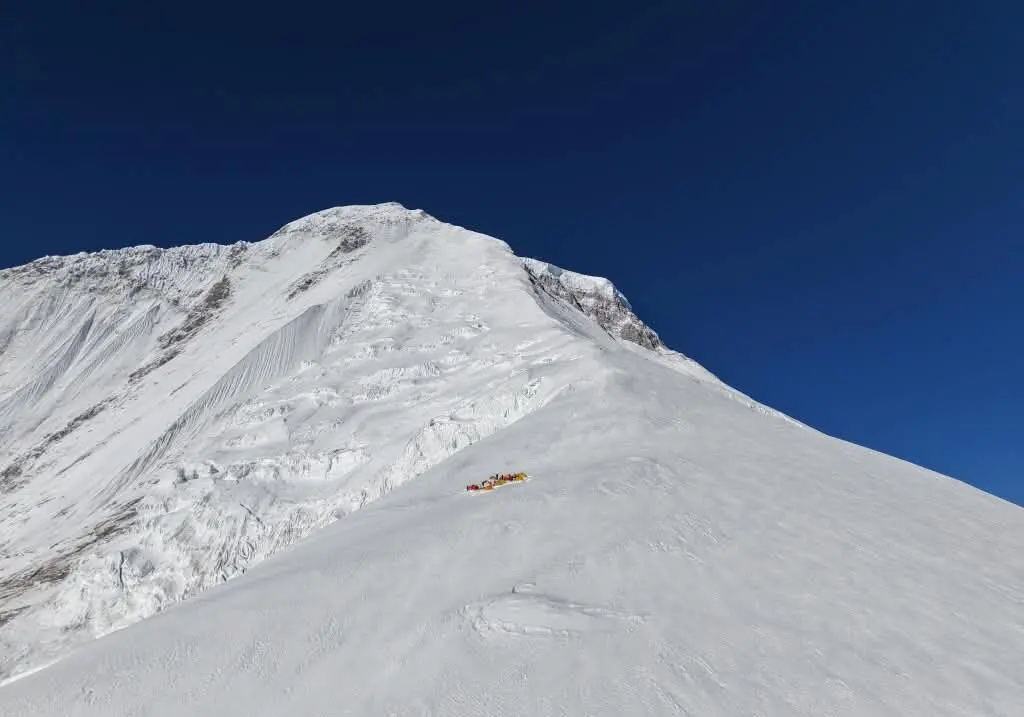
Perfect weather on Dhaulagiri — clear skies, light wind, fresh settling snow — and roughly 20 climbers from several expeditions were ready to go for the 8,167m summit. Instead, they're walking back down to Base Camp, angry and out of time.
The problem sits above Camp 3. Seven Summit Treks, the operator whose Sherpa team was assigned to fix the route this autumn, had laid ropes to around 400 metres above Camp 3 by late last week, with the team leader, Makalu Sherpa, reporting smooth progress on Friday. Then the work stopped. According to Australian climber Paul Clarke, speaking from Camp 2, the word on the mountain is that SST's top-paying "VVIP" clients are no longer planning to climb higher — removing the company's incentive to keep fixing rope for everyone else.
That matters because of how modern 8,000er climbing works. Most commercial clients on peaks of this size can't climb unaided; they depend entirely on fixed lines and a stamped trail put in by Sherpas. In recent seasons, routes on the 8,000m peaks have been set either by a team assigned by Nepal's Expedition Operators Association or by agreement among the operators on the mountain, with everyone chipping in to pay the rope-fixers. A team can legitimately halt for weather or hazard — but no safety concerns have been reported on Dhaulagiri during this push, and neither SST nor 14 Peaks Expeditions has posted an update. Unless another Sherpa team steps in, there is no summit.
The human cost is easy to tally. Clarke and his climbing partner, Xenia Santha of Hungary, sat out a storm at Base Camp two weeks ago, then waited five days at Camp 2 for this weather window. It's mid-October on a fall-season peak — realistically the last chance of the year. Finnish climber Anni Penttila put it bluntly on Instagram: everyone has turned back to Base Camp, and there was really nothing left to say.
One climber is staying put. Polish ski mountaineer Andrzej Bargiel remains at Base Camp with a large support and film crew, still aiming to climb and ski down Dhaulagiri without supplemental oxygen. He has already skied from the summits of eight other 8,000m peaks, Everest among them.
For anyone following Himalayan trekking and expedition travel, this story is a window into how fragile a commercial 8,000m summit bid really is: your turnaround may hinge not on weather or your own fitness, but on the commercial calculus of another company's rope-fixing team. Whether SST issues an explanation — safety or otherwise — will determine how this autumn season on Dhaulagiri is remembered.
Thanks to ExplorersWeb for the original reporting.