
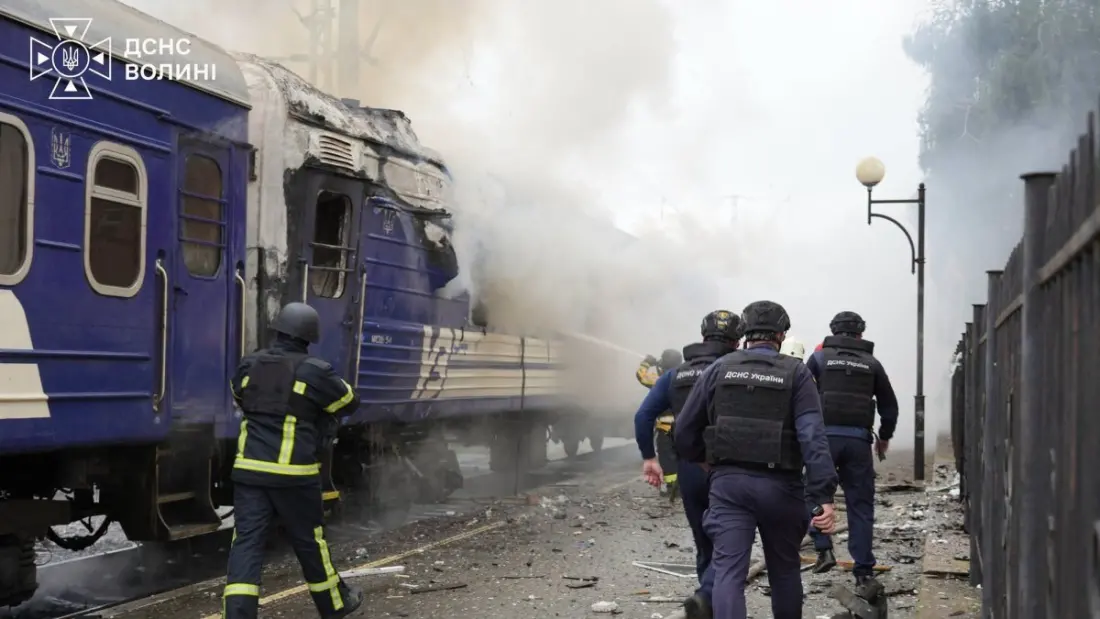
A Russian drone strike on a passenger train at Yahodyn station, close to the Ukraine-Poland border crossing with Dorohusk, came within minutes of hitting a diplomatic train carrying former UK prime minister Boris Johnson and former Swedish prime minister Carl Bildt, according to Ukraine's state railway operator Ukrzaliznytsia.
The officials had been returning from the Yalta European Strategy conference, an annual gathering in Kyiv of political, business and security figures. Ukrzaliznytsia said their train deliberately left Yahodyn ahead of schedule, and that it is 'highly probable' the drone's intended target was that diplomatic service. Bildt posted video of the aftermath, explaining that the train struck was the one arriving just minutes after theirs near the Polish border. It was evacuated as the drone approached and nobody was hurt, though his own train received an evacuation warning.
A second train, carrying former CIA director David Petraeus, was still standing at Yahodyn when the drone hit. There were no casualties reported on any of the services involved. The railway operator said it constantly adjusts schedules to reduce the risk from strikes — a grim routine for a network that has kept running throughout the war.
Reaction was swift. NATO Secretary-General Mark Rutte called the strikes a sign of desperation by Russian forces and pledged greater support for Ukraine, plus stronger defences along the alliance's eastern flank. EU foreign policy chief Kaja Kallas said the attacks were clearly meant to frighten Western countries out of backing Kyiv, while French Foreign Minister Jean-Noel Barrot, speaking at the European Arctic Summit in Finland, accused Russia of trying to divide and intimidate Europe's allies. He noted the strike came just as Ukraine hosted a major economic support forum drawing diplomats and business representatives from around the world. Downing Street, under Prime Minister Andy Burnham, said Britain would not be deterred.
For travellers, the immediate relevance is blunt: overland routes between Poland and Ukraine, including the busy Yahodyn-Dorohusk crossing used by rail passengers, sit in an active conflict zone. Ukraine's borders remain formally closed to most foreign tourists, and rail is currently the main corridor for diplomats, aid workers and those with permitted reasons to enter. Any trip involving Ukraine's rail network right now carries real risk of disruption or worse, as this incident shows — schedules shift at short notice for safety, and stations near the border are potential targets. Anyone with humanitarian, journalistic or family reasons to travel to Ukraine should monitor official Ukrainian government and railway guidance closely and follow security briefings from their own foreign ministry.
The broader takeaway is that even high-profile, protected movements near NATO territory are being targeted, and Western leaders have responded by promising more support for Kyiv rather than stepping back. Expect heightened security and continued unpredictability along the Poland-Ukraine border corridor for the foreseeable future.