
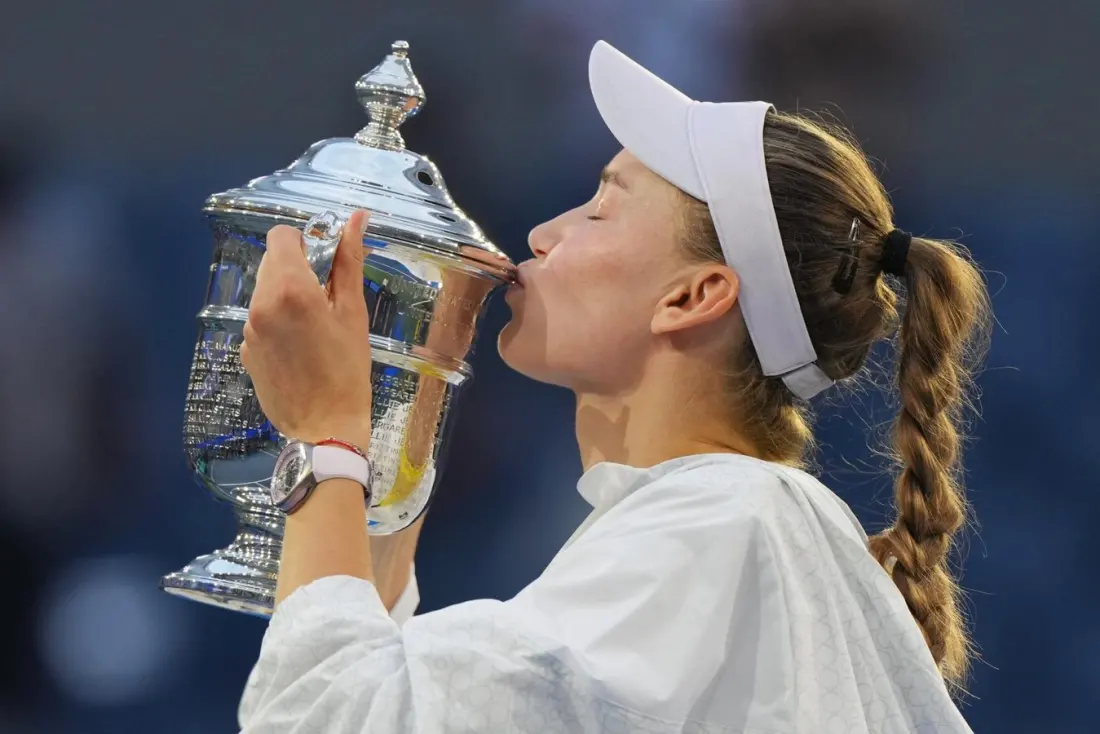
Elena Rybakina walked out of Arthur Ashe Stadium on Saturday with more than a trophy. The 27-year-old, who represents Kazakhstan, beat Aryna Sabalenka 6-4, 5-7, 6-2 to win her first U.S. Open — and in doing so took her rival's world No. 1 ranking too.
The win was layered with significance. Rybakina had already been guaranteed the top spot in Monday's rankings just by reaching the semifinals, ending Sabalenka's 99-week reign at No. 1. She then denied the Belarusian a third straight U.S. Open title, which would have been the first three-peat in New York since Serena Williams won from 2012 to 2014. Sabalenka hadn't lost at the tournament since the 2023 final against Coco Gauff, and she arrived on a 19-match winning streak there. It ended anyway.
For Rybakina, this was a third Grand Slam title and her second of the year, both won against Sabalenka on hard courts — she also beat her in the Australian Open final in January. The victory came with a $5.5 million cheque, the richest prize in Grand Slam history, and moved her level with Sabalenka and Mirra Andreeva on a tour-best three titles this season. Only the French Open is missing from her career Grand Slam collection.
What made the win striking was how she did it. Rybakina leads the tour in aces but landed fewer than half her first serves. Instead she leaned on her return game, creating 12 break chances and converting three — enough against an opponent who visibly unravelled, smashing a racket after the net handshake and firing a ball into the crowd after a first-set double fault. It was the first time since 2000 that a No. 1 vs. No. 2 U.S. Open women's final went to the challenger; Serena Williams won the previous two such meetings.
The result also flipped the season's head-to-head script. Sabalenka had beaten Rybakina at Indian Wells and Miami earlier in the year and leads their rivalry 10-8, but her form dipped oddly over the summer, with early exits at Wimbledon, Toronto and Cincinnati. Rybakina, meanwhile, had retired hurt from her Cincinnati quarterfinal against Iga Swiatek with a foot injury, yet arrived healthy in New York — a place where she had never previously passed the fourth round. "I'm falling in love with New York more and more," she said afterwards.
For travellers, this is the kind of story that explains why the U.S. Open fortnight in late August and early September has become one of New York's great spectator occasions. Flushing Meadows is an easy subway ride from Manhattan, night sessions on Ashe run late and rowdy, and the crowd plays a real part — as Sabalenka learned. Even if tennis isn't your main reason for visiting, timing a late-summer city break around the tournament gives you world-class sport, Queens' food scene and Central Park at its best in one trip.