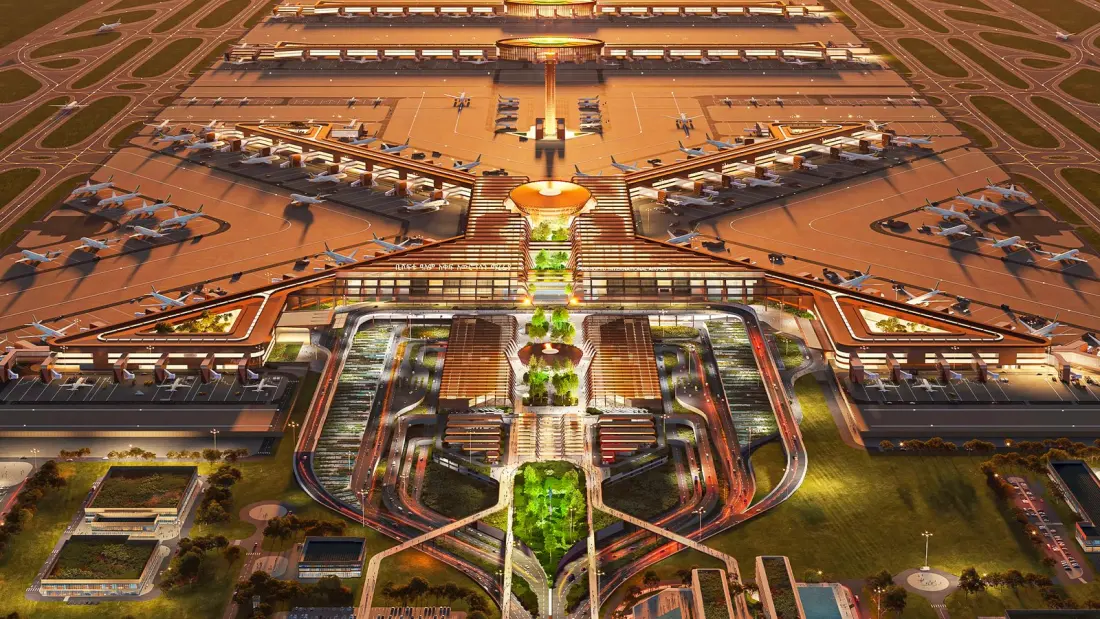
On farmland 45km southeast of Addis Ababa, Ethiopian Airlines has started building what its backers call the largest aviation project in African history. Construction on Bishoftu International Airport, designed by Zaha Hadid Architects, officially broke ground on January 10, 2026, with the first phase due to open in 2030. The price tag: $12.5 billion.
The scale is hard to overstate. Phase one alone is built for 60 million passengers a year — more than double the roughly 25 million that Ethiopia's current hub, Addis Ababa Bole International, can manage. At full build-out, with four runways and 270 aircraft stands, capacity hits 110 million annually. That would nudge past Atlanta's 106.3 million passengers in 2025, the busiest airport in the world, and dwarf Johannesburg's O.R. Tambo, Africa's current biggest hub at around 28 million.
The immediate reason is simple: Bole is full. Ethiopian Airlines carried 19.1 million passengers in the year to June 30, 2025, and its network spans 126 destinations, so gate shortages and congested taxiways already cause delays. Bishoftu is designed to take over as the airline's primary hub, with a new freeway and a 200kph high-speed rail link connecting it to the capital. A separate, purpose-built cargo zone — with long-term capacity of about 4.1 million tonnes a year — also gives Ethiopian's large freight business room to grow without fighting passenger traffic for space.
The design itself is aimed squarely at connecting travellers. Up to 80% of expected traffic is transit, a ratio closer to Dubai or Doha than to a typical national capital airport. The terminal is an X-shape with four piers radiating from a central spine, spanning about 660,000 square metres, to keep transfer times short. There's even a 350-room hotel, gardens and courtyards for long layovers.
Why should travellers care? Because it could change how Africans — and anyone flying to or through the continent — route their trips. Today, most Africans heading to Europe or the Americas connect via Istanbul or Dubai, and those layovers can require a transit visa that costs time, money or sometimes the whole trip. Ethiopia, by contrast, offers e-visas or visa on arrival to most African nationalities, so a strong Addis-based hub removes that headache entirely. If Bishoftu delivers, it becomes a genuine alternative to Gulf and European hubs for itineraries between West Africa and Asia, or Europe and Southern Africa.
Ethiopia isn't alone in betting big — similar mega-hubs are underway in Dubai, Riyadh and Singapore — but this one would make the continent's leading carrier less dependent on everyone else's airports. Ethiopian is funding nearly 30% of the project itself, with the African Development Bank and international partners covering the rest. For anyone flying long-haul across Africa in the 2030s, Addis Ababa is about to become a lot harder to avoid.