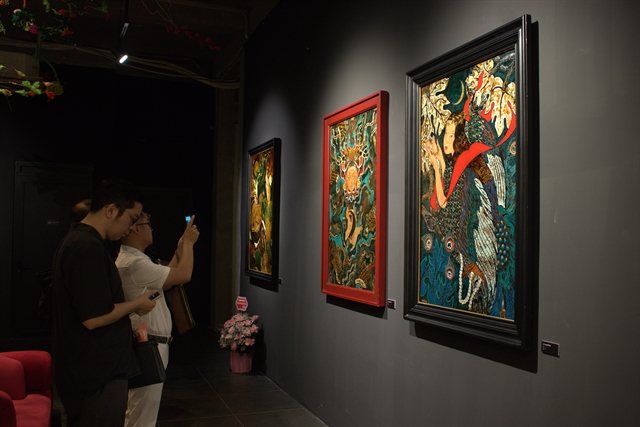
If your image of Ho Chi Minh City is motorbikes and coffee, add another layer: lacquer. Until November 10, the Toong workspace in the city's Xuân Hào Ward is hosting the second edition of Dòng Chảy Sơn Mài (The Confluence), an exhibition of 63 lacquer paintings by 20 artists that opened on October 10.
Lacquer painting is one of Vietnam's signature art forms — resin from the lacquer tree, layered with pigments, gold and silver leaf, sanded back over weeks to create depth you can't get from oil or acrylic. It's slow, laborious work, and exhibitions like this one are part of a push to keep the craft alive and in front of new audiences, both local and international.
The show is co-organised by Toong workspace, Gốc Creation and Trần Có Art Space, and it's structured as three concept spaces rather than a flat wall of frames. One section, called The Present, leans into contemporary life and the pulse of the city; others range across landscapes, everyday scenes and abstract pieces drawing on folk culture, religion and self-reflection. Because the 20 artists come from different backgrounds, the exhibition doubles as a snapshot of where lacquer art is heading — not just a museum exercise in tradition.
There are personal stories behind the works too. Artist Mai Kim Oanh, also known as Olivia Mai, is showing two paintings, one of which won a promising talent prize from the HCM City Fine Arts Association at the 2026 Traditional Lacquer Painting Exhibition in September. Her works on display are, she says, a way of preserving images of her young daughter — the kind of intimate subject matter that gives the show its warmth.
The international pull is real. One Belgian visitor, Alain Jacquemin, told organisers he tracks Vietnamese lacquer exhibitions whenever he can and was already planning to buy pieces from this one. That's worth noting if you're in the market: many works are available for purchase, and buying direct from a show like this is far more rewarding (and usually cheaper) than shopping at tourist-oriented galleries.
Why should a traveller care? Because it's a rare, time-limited chance to see serious contemporary Vietnamese art in a relaxed, informal setting — a co-working space rather than a hushed gallery — and to engage with a craft tradition that's genuinely local. Entry-level conversations with organisers and artists are common at shows of this scale, and even if you never buy, you'll come away understanding why lacquer holds the place it does in Vietnamese culture. If you're in HCM City in late October or early November, carve out an afternoon.