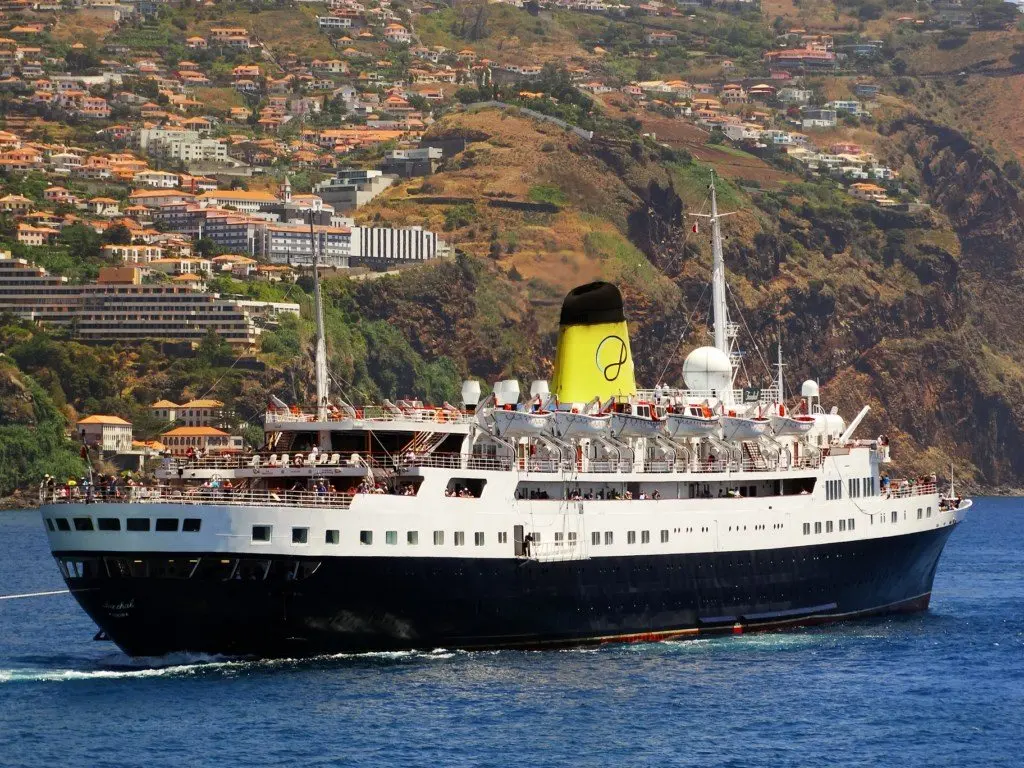
The Funchal, one of the oldest cruise ships still afloat, has found a buyer — and it may not be the happy ending fans of classic ships were hoping for.
The 9,845-ton vessel went under the hammer in Portugal earlier this month to settle the debts of her last owner, Teamson Lda, a Portuguese company now in insolvency proceedings. According to Portuguese daily Correio da Manhã, the winning bid came from a Greek shipowner who offered just above the minimum asking price of €802,354. Financial outlet Jornal de Negócios reported that two international companies competed, with the Greek bidder prevailing. That owner reportedly runs shipyards in Greece, including repair and dismantling facilities.
But there's a competing story. JM, a newspaper based in Madeira — where the ship's name comes from — claims the buyer is actually a Turkish scrapping company, and that the Funchal will be broken up at the Aliaga shipbreaking yard. If so, she'd follow a familiar path: her former fleet mates with Portuscale Cruises, the Princess Danae and the Arion, were also auctioned off by Portuguese authorities and beached at Aliaga in 2015 and 2018 respectively.
Built in 1961, the Funchal was originally designed to connect mainland Portugal with its Atlantic islands, including Madeira. She carried 402 passengers and spent much of the past decade laid up in Portugal. Teamson Lda had planned an unusual second life for her as a stationary hotel, and the conversion was already underway: the ship went into drydock, and hazardous materials — including all asbestos — were stripped from her interior. Auctioneers confirmed the vessel is asbestos-free and even licensed for hotel use, though the project stalled before completion.
That detail matters. An asbestos-free, hotel-licensed ship theoretically could have served as a floating hotel or boutique property, and preservationists will be watching which version of the story proves true. A Greek repair yard could, in theory, mean further service or a commercial repurpose; Aliaga almost certainly means the end of the line. At just over €800,000, the price reflects a ship valued more for scrap steel and salvage than for heritage.
For travellers, the Funchal is a reminder of how few classic mid-century cruise ships survive. If vintage-ship experiences appeal to you, the window is closing — vessels like these are steadily disappearing from the world's fleets, so sailing on a preserved historic ship is something worth doing sooner rather than later. Whether the Funchal becomes a hotel, a working vessel, or another beached hulk at Aliaga, an important piece of Portuguese maritime history is entering its final chapter.
Details remain thin until the buyer confirms their intentions, so expect more clarity in the coming weeks.