Sofia is throwing one of its biggest historical moments in years: the remains of Tsar Samuel, the medieval ruler who commanded the First Bulgarian Empire in its final decades, are being handed over by Greece in a ceremony on Saturday.
The deal took nearly two decades of formal negotiation, with Bulgaria opening talks in 2007. As part of the swap, Athens receives 48 religious objects taken by Bulgarian troops from churches and monasteries in northern Greece during World War I. For anyone who loves the Balkans' layered, complicated past, this is the region's history playing out in real time.
Samuel reigned from 997 to 1014, fighting repeated campaigns against the Byzantine Empire and building his power base around Lake Prespa and Lake Ohrid — territory now shared between Greece, Albania and North Macedonia. His end was grim: after his army was crushed in 1014, Byzantine emperor Basil II — remembered as the "Bulgar Slayer" — ordered thousands of captured soldiers blinded, and Samuel is said to have died of shock at the sight.
The bones themselves have quite a backstory. Greek archaeologist Nikolaos Moutsopoulos excavated them in the 1960s on the tiny Greek island of Saint Achilleios on Little Prespa Lake, near the triple frontier. The skeleton — a man of about 1.6 metres — was found wrapped in gold-edged silk decorated with bird motifs, and the tomb's location, the luxury of the burial and other clues led researchers to attribute the remains to Samuel.
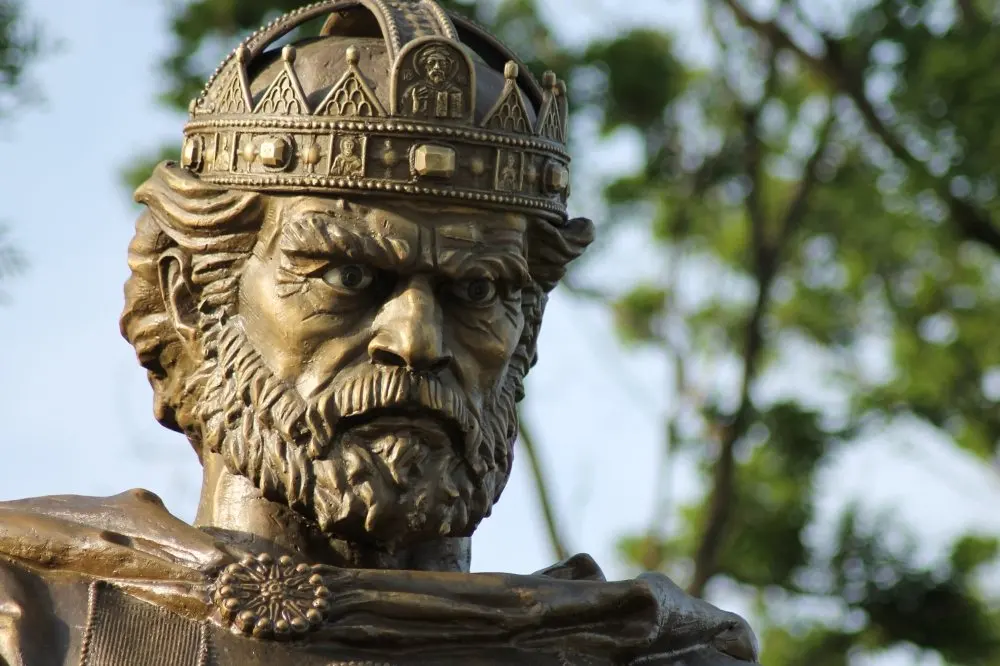
But the handover is more than an archaeological footnote. North Macedonia also claims Samuel as its own, and his statue looms over central Skopje. Newspapers there have called the return another battle over history; one Albanian-language daily put it bluntly: the bones return, the conflict remains. Some historians compare it to France and Germany arguing over Charlemagne. A 2022 bilateral commission suggested presenting Samuel as ruler of an empire most historians consider Bulgarian, though based in what is now North Macedonia — the kind of compromise that satisfies almost nobody.
For travellers in Sofia this weekend, the city will feel the occasion: free trains are running to the capital, and around 750 police will guard the centre. The remains will be placed in a white sarcophagus of marble from the Prilep region of North Macedonia, then rest in the Church of Saint Sofia — the sixth-century basilica that gave the Bulgarian capital its name. It's a good excuse to visit a church most tourists stroll past on their way to the nearby Alexander Nevsky Cathedral.
The political backdrop is pure Balkan drama: the handover has sparked a credit-claiming row in Bulgaria during a presidential election campaign, with the incumbent leaning hard into the patriotic moment. Whether you're drawn by medieval history, the Ohrid lakes region, or simply the spectacle of a 1,000-year-old homecoming, Sofia right now is where the story lands.
Reporting via AFP, as published by Malay Mail Life.