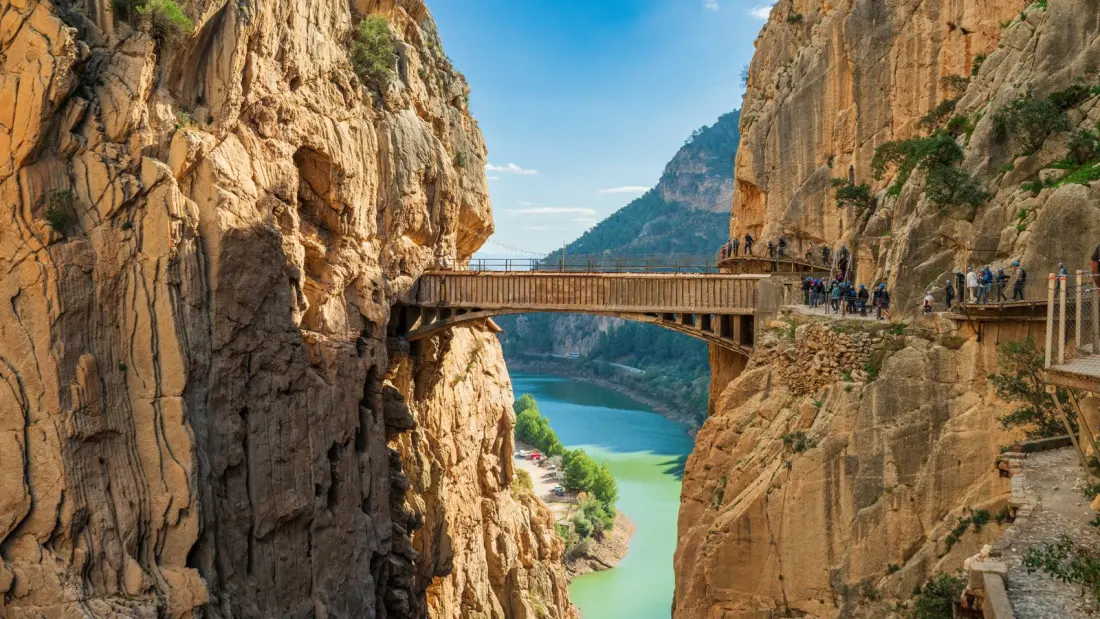
A century ago, this path was a rickety line of iron rods and planks pinned to a gorge wall, built for hydroelectric workers. After fatal falls around the year 2000 forced officials to close it — they even demolished the entrance — the Caminito del Rey earned its grim reputation as Spain's most dangerous walkway. A full reconstruction changed that, and since 2015 it's been one of Andalusia's most popular days out.
The route runs one way through the Desfiladero de los Gaitanes, a limestone gorge cut by the Guadalhorce River about 328 feet below, linking Ardales in the north to El Chorro in the south. The boardwalk itself is just under two miles, but with approach paths the whole thing stretches closer to five, and you should budget around four hours door to door. Wooden walkways are bolted straight into the cliff, tunnels punch through the rock, and the old concrete path is still visible beneath your feet in places — a reminder of how far the restoration has come.
Tickets cost 10 euros and must be booked on the official website; slots sell out fast in summer. It's open Tuesday to Sunday, helmets are compulsory, and there's paid parking plus a shuttle at the visitor centre. From Málaga, about 37 miles away, you can drive the A-357 or take the train to El Chorro. One honest caveat: if you suffer from vertigo, this isn't your walk — the source suggests the seaside town of Nerja as a gentler alternative.
The walk is only half a day, so pair it with nearby sights. The Cueva de Ardales, six miles away, is an enormous cave system estimated at 2.5 million years old, revealed by an earthquake in 1821; it holds an underground lake, stalagmites and prehistoric paintings, visited only in small guided groups that book up early. Also close by are the ruins of Bobastro, where a ninth-century Mozarabic church was carved directly into the rock alongside a Moorish fortress and necropolis — both are part of a bid for UNESCO World Heritage status. Finish in Ardales itself, a whitewashed town of steep streets climbing to a medieval castle with views over the turquoise reservoir, and grab traditional Andalusian food at El Cruce before you go.
Practical notes: it gets fiercely hot on the cliff face, especially wearing a helmet, so carry plenty of water and enjoy the cool air in the tunnels. Watch for griffon vultures and golden eagles nesting on the clifftops, and note that small-town tourist offices in this part of Andalusia can be unreliable — check hours ahead.
Why it matters: this is one of Europe's most dramatic walks at a remarkably low price, an easy add-on to any Costa del Sol trip, and proof that a site can be rescued from ruin without losing its edge. Book both the walkway and the cave well in advance and you can turn a half-day thrill into a full weekend of gorge scenery, cave art and quiet white villages.