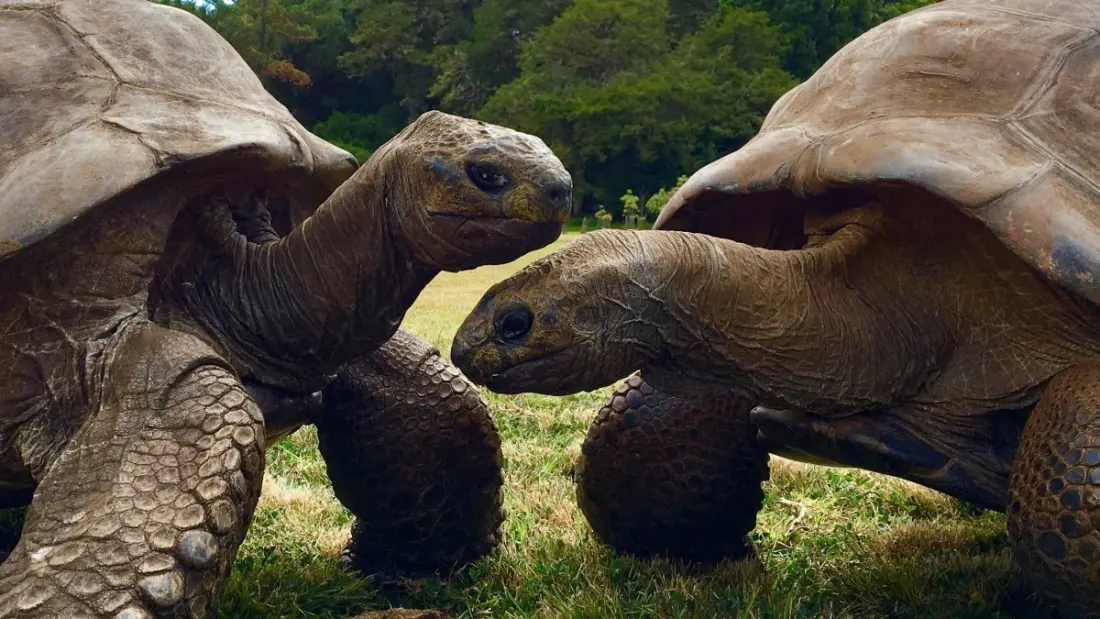
The world's oldest known land animal lives in a paddock beside the governor's house on one of the most remote islands on Earth. Jonathan, an Aldabra giant tortoise estimated at around 194 years old, has been a resident of Plantation House on St Helena since 1882, when he arrived as a fully grown adult, probably from the Aldabra Atoll or the Seychelles. Guinness World Records has now given him official 'icon' status.
A new study published in Science Advances has been digging into why he has lived so long, sequencing his genome and mapping his epigenome. Researchers found gene variants tied to DNA repair, tumour suppression and efficient mitochondria, plus lower-than-expected chemical 'noise' in the DNA switches that regulate ageing — in some of those regions, his cellular profile looked closer to a 5-year-old juvenile than a near-two-century-old reptile. Scientists compared the epigenome to handwritten notes in a cookbook: most of Jonathan's notes look ancient, but the crucial ones remain freshly legible.
Getting a sample wasn't straightforward. Blood draws are restricted on the island for infection reasons, so researchers used a decoy feeding trick — when Jonathan bit at the air, they gently wedged his mouth open and scraped cells from under his tongue. His longtime vet, Joe Hollins, says the old boy still perks up and stretches his neck at the sound of his name, mostly because he associates it with food. Once famous for overturning chairs and lying on croquet balls, Jonathan is now mostly blind from cataracts but described as a gentle giant with a voracious appetite.
The findings echo research on exceptionally long-lived humans, including a 117-year-old woman with unusually efficient mitochondrial function, hinting that some ageing mechanisms cut across species. The caveat: this was a single remarkable animal, and his carefully managed island diet may have helped too.
For travellers, the story doubles as a reason to put St Helena on the map. The island is far more than a tortoise paddock — it's a subtropical volcanic outpost in the South Atlantic, famous as Napoleon's place of exile, with dramatic walking trails, whale sharks in season and a small, welcoming community. Seeing Jonathan munching grass at Plantation House is free and easily the island's most beloved sight. He has lived through two world wars and the fall of empires; a visit puts you face to face with a genuinely singular piece of living history.
With thanks to Daily Sabah Travel for the original report.