
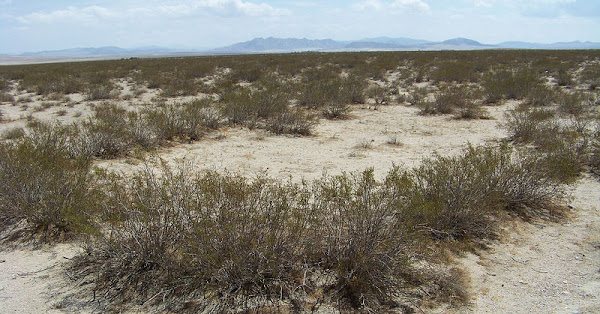
Off Bessemer Mine Road near Pioneertown in California's Mojave Desert, there's a circle of scruffy shrubs that most drivers would cruise straight past. They shouldn't. That ring, known as King Clone, is a single clonal colony of creosote bush (Larrea tridentata) estimated at roughly 11,700 years old — a living organism that predates agriculture, writing, and just about everything else humans have built.
King Clone isn't one bush but many stems, all genetically identical, all descended from a seed that germinated as the last Ice Age was ending. When mammoths had only just vanished from North America and sea levels were still climbing, this plant was already putting down roots. The original central stem died long ago, but creosote bushes survive by splitting: old branches die back, the crown divides, and new growth pushes outward at the edges. Over millennia the centre withers and a ring forms. Every piece of that ring counts as one organism.
Botanist Frank Vasek and his team identified the colony in the early 1970s after spotting an unusually large, symmetrical circle in aerial photographs — from the ground it looks like nothing special, but from above the perfect ring gives the game away. To date it, they used two independent methods: measuring the ring's outward growth rate and radiocarbon-dating dead wood from its centre. Both landed near the same figure, about 11,700 years.
The scale is modest but the patience is staggering. The ring spans up to 20 metres across, averaging around 14 metres. When Sir David Attenborough returned to film it in 2022, forty years after his first visit, it had grown less than an inch. Empires have risen and collapsed in the time this plant took to add a centimetre.
Today King Clone sits inside the King Clone Ecological Reserve, fenced off with restricted access to protect the fragile colony. And that's the practical takeaway for travellers: this is a look-don't-touch destination, and even looking requires effort — it's deep in the high desert, reachable via unsealed roads north of Pioneertown and Yucca Valley. Visitors to the area, perhaps combining a trip with Joshua Tree National Park or a stop at Pioneertown's famous western movie set and Pappy & Harriet's, can add it to a desert itinerary for a genuinely humbling detour. Just bring water, respect the fencing, and remember you're peering at something that has outlasted every human civilisation in existence.