
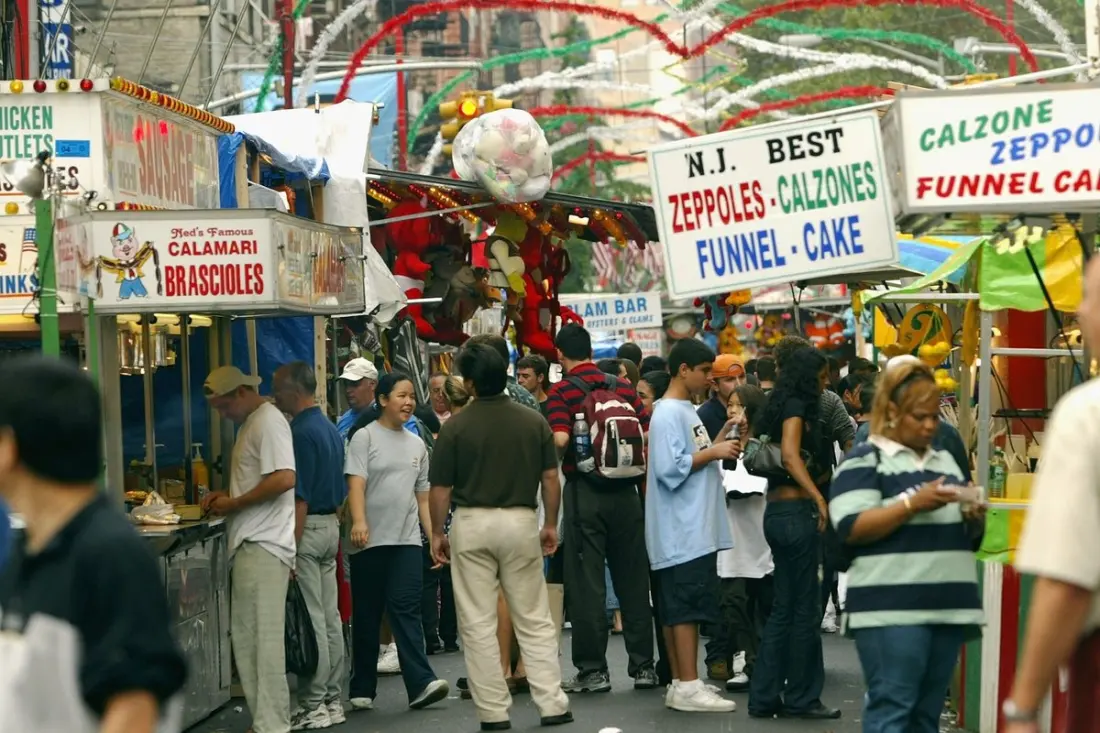
For eleven days every September, Mulberry Street in Manhattan becomes the loudest, tastiest corner of Italy this side of Naples. In 2026, the Feast of San Gennaro hits its centenary — making it the largest and longest-running Italian festival in the United States, and this year's edition is dedicated to the Italian Americans who helped build New York.
The festival started small. In 1926, parishioners at the Church of the Most Precious Blood on Baxter Street, led by Alexander Tisi, organised a tribute to San Gennaro — an early Christian bishop beheaded outside Naples in AD 305 during the Roman persecutions. The first celebration featured a three-foot statue carried on men's shoulders, dollar bills pinned to the saint's robes, and a bone fragment of the saint hung around his neck in a reliquary. It worked: by 1928, The New York Times noted thousands of ex-Neapolitans attending and the feast stretching to a full week.
The saint himself comes with serious legend attached. Two vials of his blood have been kept in Naples since at least 1389, and their mysterious liquefaction on his feast days is read as a sign of his protection — when it failed in 1943, Allied bombs fell on Naples soon after. He's also credited with stopping Vesuvius's fires in 1631. Naples marked his feast with pork feasts and street games, even greased-pig wrestling inside the cathedral, and southern Italian immigrants brought that spirit to Manhattan's Lower East Side.
Not everyone welcomed it. In 1928, the city's police commissioner banned the procession, calling the dollar-pinning a profanation of sacred symbols, before a New York Supreme Court judge reversed him on religious liberty grounds. Italian immigrants also faced the usual weight of discrimination — slurs, suspicion of criminality, accusations of refusing to assimilate. Things loosened after World War II: by 1949, crowds of all backgrounds were dancing in the streets under green, white and red string lights, and by the 1970s attendance had swelled to around three million a year.
Today it's a gloriously commercial affair — sausage and peppers carts, chicken parm subs, Sinatra impersonators, Godfather merch at eye-watering prices — but the century-old procession with the dollar-bedecked statue still anchors it all. The centenary lands amid some awkwardness: New York's mayor recently left Little Italy off a map of the city's immigrant neighbourhoods, prompting backlash and a pointed reminder that few Italians actually live on Mulberry Street now. Organisers have framed the 2026 feast as a tribute to the city's whole cultural melting pot — a celebration of the people who built it, even if their descendants have moved on.
If you're in New York in mid-September, it's free, it's crowded, and it's the best excuse you'll get to eat cannoli standing up on a historic street. Go hungry, go early on a weekday if you can, and catch the grand procession — the heart of the whole thing, exactly as it was in 1926.
Via The Independent Travel.