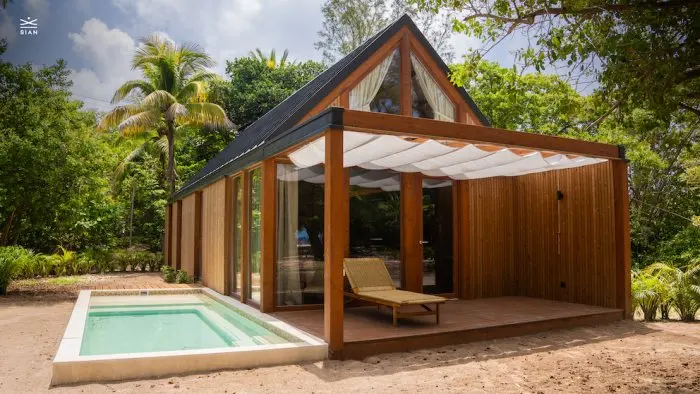
A Mexican company called SIAN believes it has an answer to one of hospitality's slowest problems: building new hotel rooms takes far too long. Its first property, SIAN Yáax on Isla Mujeres, went from confirmed project to open in a fraction of the usual timeline — and it was screwed into the ground rather than set in concrete.
The numbers make the case. A conventional hotel expansion in somewhere like the Riviera Maya can take one to two years. SIAN's factory-built approach cuts manufacturing to 30-60 days, transport to around a month, and on-site installation to roughly four weeks. If a unit is already in stock, the whole process can wrap in two to three months. At Yáax, the foundation system went in in a day and a half, with no heavy machinery required.
How it works: each unit is mostly built in a controlled factory, then shipped and assembled on site. Instead of concrete foundations, the 90 sqm structure sits elevated on 32 removable foundation screws, which keeps the soil beneath permeable and means the building can later be dismantled and moved elsewhere. There's a sustainability angle too — FSC-certified wood, thermally modified exteriors treated with heat rather than chemicals, and precision factory manufacturing that cuts waste.
For hoteliers, the pitch is flexibility. Luis Gutiérrez Ureña, the company's CEO and co-founder, argues properties shouldn't have to commit to years of construction just to grow. Operators can install a handful of units, test demand, then scale up — with existing rooms, villas or wellness spaces added while the rest of the hotel stays open. Costs, the company says, are largely locked in at the factory stage, reducing surprises from material prices or site conditions.
SIAN Yáax opened on 1 September and doubles as a live case study under the company's SIAN Retreats brand. Two more units are being prepped for a project at the Puerta al Cielo cenote in Tulum, with further talks underway in Mexico and Spain, certification work in Canada, and interest in the Dominican Republic and the US. Early demand, notably, is coming from small and mid-sized operators — landowners eyeing micro-resorts and premium glamping, plus existing hotels wanting extra keys without a building site.
For travellers, the practical takeaway is that the places you stay may soon change more quickly — new villa clusters, wellness retreats and glamping-style escapes appearing in sensitive natural spots with far less churn and disruption than a traditional build. Whether modular rooms feel as polished as conventionally built suites is the open question, but the model lowers the barrier for independent and boutique operators to add inventory, which usually means more characterful options rather than fewer.
If SIAN's timelines hold, a concept can go from drawing board to bookable in a single season — a genuinely different rhythm for destination development.