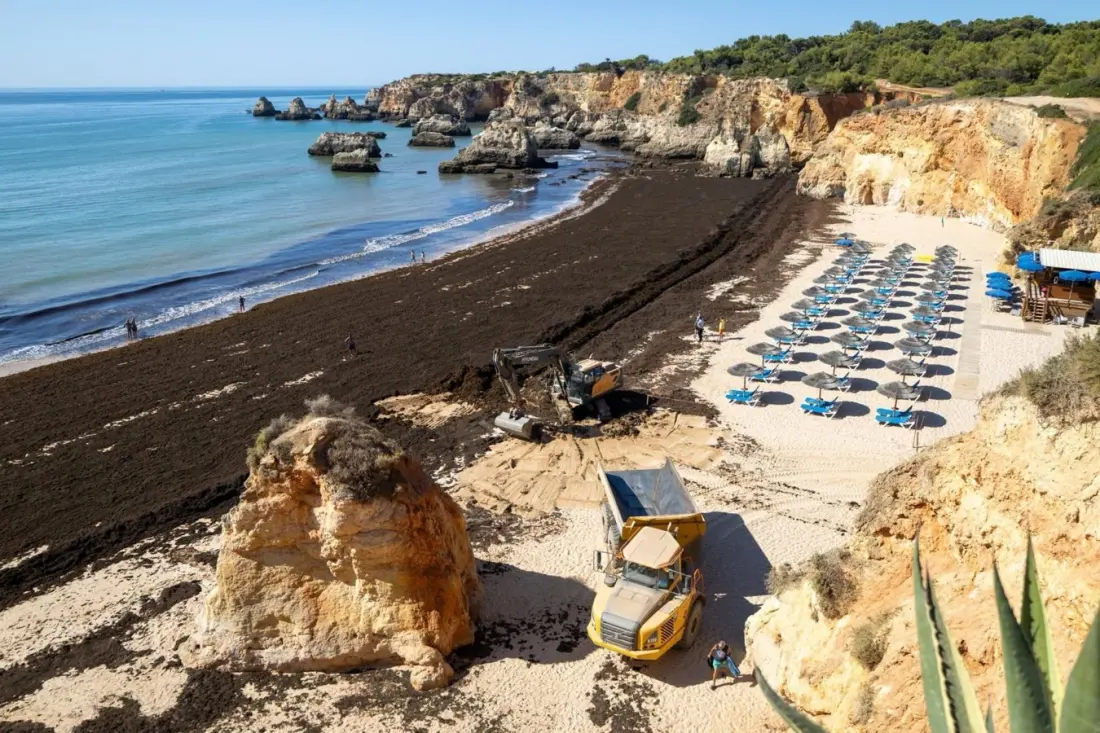
Portugal has given the green light to a national action plan running from 2026 to 2030 to manage Rugulopteryx okamurae, a fast-spreading brown seaweed that has been washing up in smelly drifts on beaches from the Algarve up through the Alentejo and around Lisbon. If you've holidayed on the Algarve in recent years, you may have seen it yourself: thick mats of dark algae that make swimming less inviting and leave councils with costly clean-ups.
The programme, overseen by Environment and Energy Minister Maria da Graça Carvalho, is deliberately billed as containment rather than cure. The ministry considers total eradication practically impossible now that the species is so widely established, so the focus shifts to monitoring, rapid response when it pops up in new spots, and reducing its impact where it's already entrenched.
The toolkit sounds more like a science project than a beach clean-up: satellite imagery and drones to spot outbreaks, underwater sensors, remote cameras in critical areas, containment and deflection barriers, and manual or mechanical removal depending on the site. A national georeferenced database will track everything, and Portugal wants a standing communication channel with Spain and other countries battling the same invader. There's also money earmarked for research into sustainable removal and possible uses for the harvested biomass, plus ecological restoration of damaged marine habitats.
For travellers, the backstory matters as much as the plan. The seaweed, native to the North Pacific, is on the EU's list of invasive alien species of concern. It first showed up in mainland Portugal in the Algarve in 2021, marched along the Alentejo coast, and has been spotted around Cascais since 2024. In the Azores, where it arrived in 2019, it's now on eight of the archipelago's nine islands. It likely travels via ships' ballast water and hulls, fishing gear and aquaculture, alongside natural ocean dispersal.
The knock-on effects hit holidaymakers indirectly: reduced catches and damaged gear for fishermen, heavy removal bills for coastal councils, and beaches that look far less appealing when the stuff piles up. That's why the plan includes training and awareness campaigns aimed at the tourism and fishing sectors and the municipalities on the front line.
The practical takeaway for anyone planning a Portuguese coastal break: the country is taking this seriously, and the worst-affected stretches should see better-managed clean-ups over the next few years. Beach conditions still vary by town and season, so if a spotless stretch of sand is the point of your trip, it's worth checking recent local reports for specific resorts before booking — especially on the Algarve and Azores, where the problem is most established.