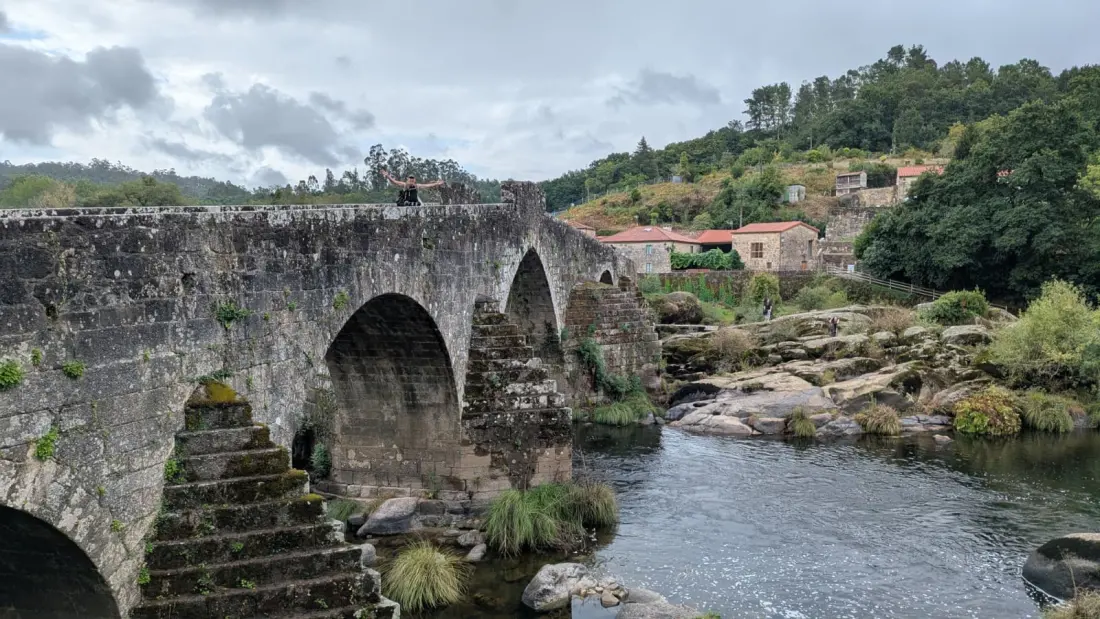
A long day's walk in the rain, an albergue in a town too small to name, and a communal dinner of lentil soup and orange cake — this is the Camino de Santiago in its last stretch toward Santiago de Compostela, and it captures exactly why hundreds of thousands of people walk it every year.
The scene: a husband-and-wife walking team pushing through a 14-mile day, well before sunrise, umbrellas up, feet wet anyway. Spain's pilgrim trails don't always space the towns a tidy ten miles apart, so some days run long. Their lodgings that night were a former rectory next to a locked church — a seasonal albergue hosting a small international crowd, including five Japanese pilgrims who bonded instantly with the couple over the Kumano Kodo, Japan's own long-distance pilgrimage, which the couple had walked earlier in 2025.
Small comforts matter enormously out here. The couple splurged on a private room — a rare luxury when most albergues mean bunk beds, communal snores, and rubber-coated mattresses covered in disposable polyester sheets. The real motivation wasn't comfort but bedbugs, a genuinely common fear on the route and one their friend Suzanne had lived through on the Portuguese Camino two years earlier.
The heart of the story is human. A fellow pilgrim, a Hungarian-American named Jess, had improvised her walk after travel plans collapsed — finishing the Portuguese Camino from Porto and deciding to push on to Finisterra, the 'end of the earth' on Spain's Atlantic coast. She was in pain and considering a rest day in a town with nothing to do. Three fellow pilgrims — a pastor, a chiropractor, a professor — each listened through their own professional lens, and it turned out one of them, Rosanne, was a chiropractor. Jess walked into Finisterra the next day, covering in one day what had taken the couple three. Healed, as the writer puts it: sometimes you walk the Camino, sometimes it walks you.
The trail's small strangenesses are half the fun: a schoolgirl in uniform petting three pet chickens outside her house, eucalyptus-scented air alternating with farm smells between fields, and pareidolia games — both walkers photographing the same 'old woman' shape by the roadside without realizing it until later. And then, cresting a hill, the first distant view of the Cathedral of Santiago de Compostela, still hours of walking away.
Why should this matter to you if you're considering the Camino? Because the logistics are simple but the texture is everything. Expect communal dinners with strangers from Poland, Croatia, Italy, Japan and the American Midwest — guarded at first, warmer by dessert and the pitchers of wine. Expect rain, and consider an umbrella; it keeps you cool and moving. Expect albergue life to be basic, and budget a few nights in private rooms as a reset. And expect the trail to hand you exactly the conversation or the kindness you didn't know you needed.