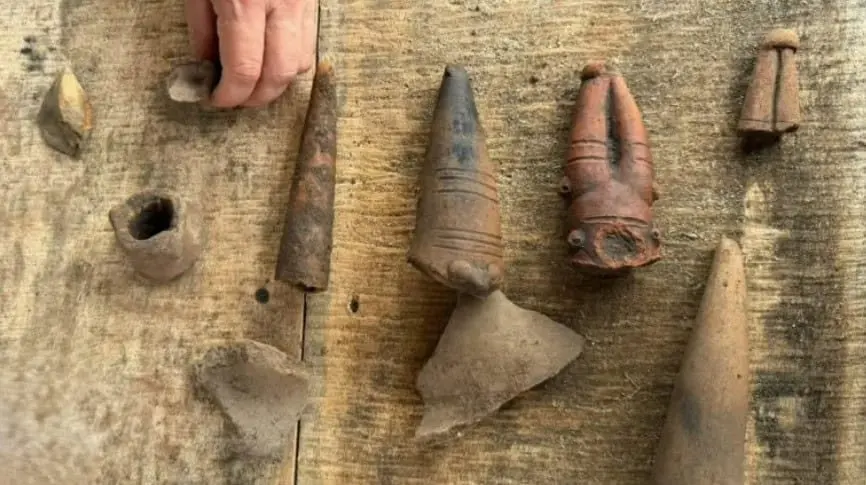
A routine school construction project in Costa Rica's southern hills has turned into an archaeology story. Crews rebuilding the Liceo Rural Buena Vista, a rural high school in Pérez Zeledón, uncovered materials in the ground that may have heritage value — enough for the government to stop and take a closer look.
According to a statement from the Ministry of Culture and Youth released on Sept. 19, the Ministry of Public Education (MEP) and the National Commission for Risk Prevention and Emergency Response (CNE) secured the site and called in the National Museum. An archaeologist arrived the following day to assess the extent, characteristics and spread of whatever surfaced during the works. Officials haven't said what the materials actually are or when results will be made public.
There are two likely paths forward. If the evidence turns out to be limited and well-defined, the museum can run a targeted rescue — recover the objects and let construction resume. If the find covers a wider area, the museum will draw up a broader work plan in coordination with the education ministry and the CNE. Either way, everything falls under Law 6703, which protects objects and remains from Indigenous cultures that existed before or during the Spanish settlement of Costa Rica.
Culture Minister Jorge Rodríguez Vives praised the swift response, noting that the country's archaeological wealth demands protection under technical and legal criteria. The school rebuild itself is funded through PROERI, a resilience-focused infrastructure programme carried out under a CNE emergency declaration, with the CNE coordinating and the MEP overseeing the works.
For travellers, the location is no surprise. Costa Rica's southern region is among the country's richest archaeological zones. The nearby Diquís Delta is home to the famous pre-Columbian stone spheres, whose associated settlements earned UNESCO World Heritage status in 2014, and earlier digs around Pérez Zeledón have documented Indigenous ceremonial and burial sites. If the school find is confirmed, it would add another chapter to a region where ancient history sits surprisingly close to the surface — sometimes literally under a football field or, in this case, a classroom block.
It's a small story with a wider point: in Costa Rica, heritage law has real teeth, and even an emergency school rebuild stops dead the moment the ground suggests something older. For visitors interested in the country's pre-Columbian past, the south Pacific lowlands — from Pérez Zeledón down to the Diquís Delta and sites like Finca 6 near Palmar Sur — are well worth adding to an itinerary, especially combined with the nearby cloud forests and coast.