For three decades, one of the most valuable meteorites ever found in Michigan had a humble day job: propping open a shed door. The 10.22-kilogram (22.5-pound) chunk of iron and nickel now known as the Edmore meteorite sat unnoticed on a farm near Edmore, Michigan, where it was used as a doorstop from the late 1980s until 2018.
The backstory is what makes it special. When Grand Rapids resident David Mazurek bought the farm in 1988, the previous owner told him he and his father had watched the object streak down and slam into the property one night in the 1930s. They dug it out of a crater the next morning, and it was reportedly still warm. Mazurek kept the story — and the rock — and thought nothing of letting his kids haul it to school for show-and-tell.
Everything changed in 2018, when Mazurek heard that small meteorite fragments were fetching serious money. He took the doorstop to Central Michigan University, where geologist Mona Sirbescu — who had seen plenty of bogus space rocks before — realised this one was the real deal. A sample went to the Smithsonian Institution, where geologist Cari Corrigan helped confirm it as an iron meteorite: roughly 88.5% iron and 11.5% nickel, classified as Iron IIIAB. Under the microscope, it even showed a Widmanstätten pattern — interlocking crystal bands that only form when iron and nickel cool over millions of years inside the core of an ancient planetary body. Formal approval of the name Edmore came on 1 January 2019, though the official record lists it cautiously as a find with a doubtful fall, since the 1930s sighting was never independently verified.
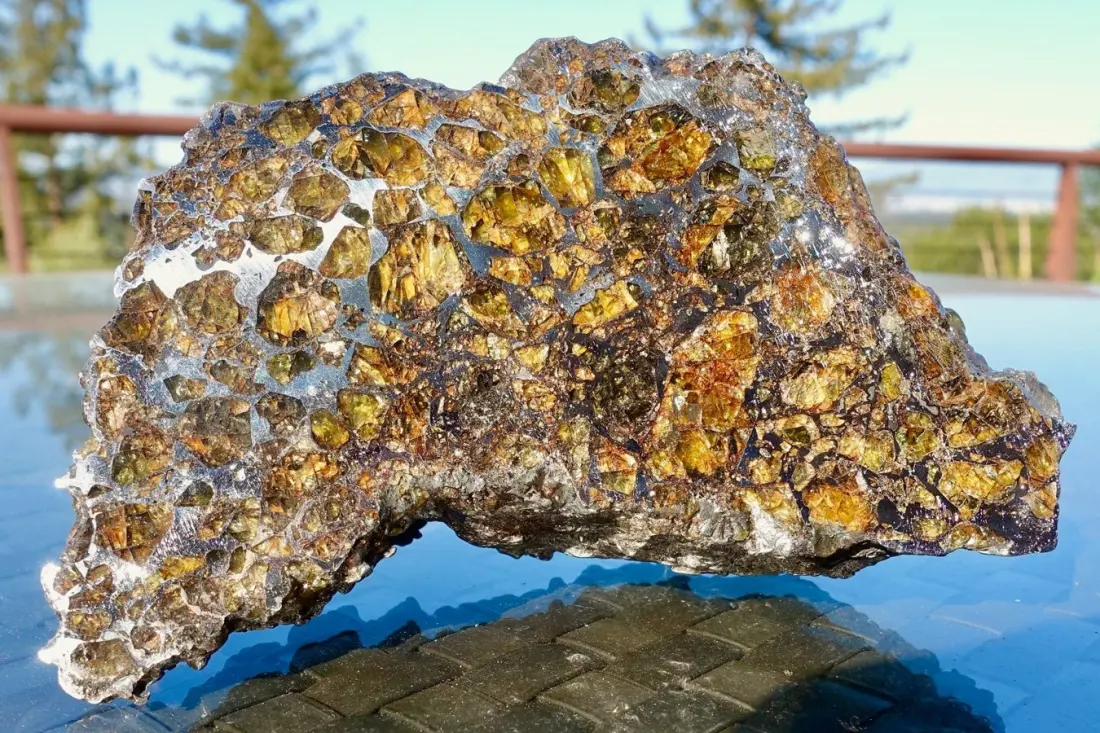
The rock measures about 17 by 20 by 23 centimetres, has a light-brown fusion crust from its fiery arrival, and was appraised at around US$100,000. Mazurek sold it for US$75,000 to Michigan State University's Abrams Planetarium in East Lansing, pledging 10% of the proceeds back to CMU's earth sciences department. Instead of holding a barn door open, the Edmore now anchors a planetarium exhibit of Michigan meteorites.
Why should travellers care? It's a great excuse to add a quirky stop to a Michigan road trip. Abrams Planetarium on MSU's campus gives you the chance to see a genuine piece of an asteroid's core up close — no telescope required — and the surrounding Great Lakes region is full of similar small-town surprises. It's also a reminder for anyone trekking through the countryside: that odd heavy rock on the farm might be worth a second look.