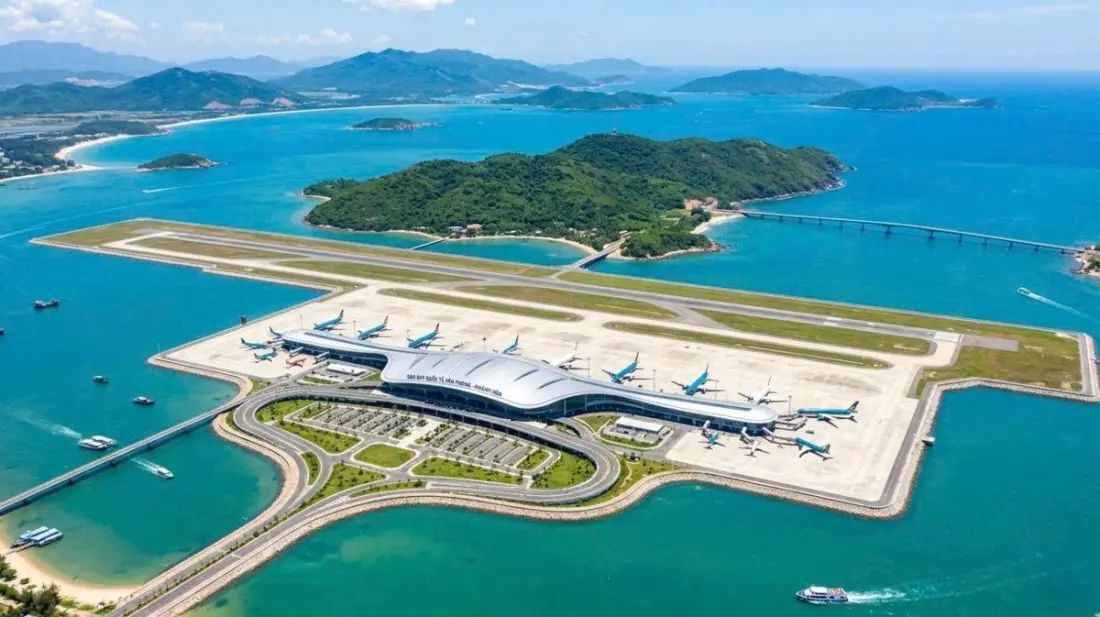
A stretch of shallow coastal water in Khanh Hoa Province could soon become home to Vietnam's first offshore airport. The proposed Van Phong Airport would rise across roughly 497 hectares of nearshore waters in Van Thang Commune, about 65km from Nha Trang's city centre — and its master plan details have just been laid out.
Despite the "offshore" label, this isn't a futuristic artificial island like Japan's Kansai International, which sits alone in Osaka Bay. Instead, the design uses intertidal water close to the shore, near the mouth of a small tidal creek known locally as the Goc River. The site currently has no residents, no protected mangroves and no designated anchorage zones — just aquaculture ponds, rice fields and orchards a few hundred metres inland, near Nguyen Hue Street and the small Van Thang fishing port to the south.
The numbers behind the plan are substantial. Van Phong is designed as a 4E-grade airfield under ICAO standards, the same class that handles wide-bodied international jets. Capacity is set at around 1.5 million passengers a year by 2030, rising to 2.5 million by 2050, with total investment projected at roughly 9.2 trillion VND (around USD 360 million).
Location-wise, the airport slots neatly between existing infrastructure: about 108km north of Cam Ranh International Airport, which serves Nha Trang today, and 48km south of Tuy Hoa Airport in Phu Yen. The idea is to give the South Central Coast and Central Highlands a dedicated gateway, tightening links to the Van Phong Economic Zone — a 2040 master-plan priority for the province — and, in theory, opening up the bay's tourism and logistics potential.
Why should holidaymakers care? Van Phong Bay is one of Vietnam's most quietly beautiful coastal areas, a lower-key alternative to Nha Trang's developed beach strip. It's home to Diep Son Island, famous for a sand path that appears at low tide and is visible across the bay from the planned site. If the airport goes ahead, reaching this corner of the coast could go from a long drive to a direct flight — which means expect more resorts, better roads and heavier footfall in the years after opening.
For now, the project is still at the proposal stage, so travellers shouldn't rewrite any itineraries yet. But anyone with an eye on Vietnam's emerging coastal destinations — or who simply wants to see Van Phong Bay before mass tourism arrives — has a reasonable window. Once the diggers move in, the unspoiled shoreline around Van Thang will look very different.