
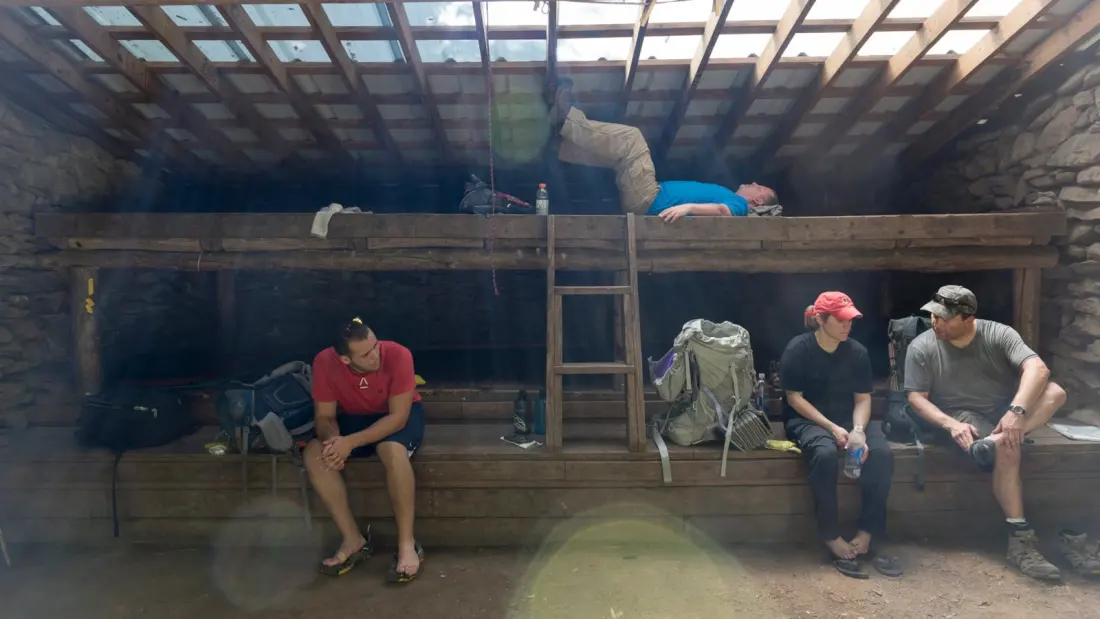
For nearly a century, the lean-to shelters dotted along the Appalachian Trail have been as much a part of the experience as summit photos and trail magic. But the way hikers camp is changing, and the trail's managers are changing with it — phasing out some aging shelters, reworking others, and building designed tent pads in their place.
The push started with a mess. Hawk Mountain Shelter, about eight miles from the trail's southern terminus at Springer Mountain in Georgia, was getting hammered during thru-hiker season, with up to 100 hikers a day arriving for a structure that sleeps a dozen. The overflow spread into the forest, and by 2015 the trampled, eroded impact zone covered roughly four acres. That year, the Appalachian Trail Conservancy's Morgan Sommerville teamed up with the Georgia Appalachian Trail Club, the U.S. Forest Service, and recreation ecologist Jeff Marion to try something different.
Beginning in 2016, they roped off the damaged ground, launched a registration system to stagger start dates, added bear boxes, and — the real innovation — carved 30 tent pads into steep slopes along half a mile of trail. The logic: people will camp where a good flat spot exists, so build those spots deliberately on terrain that discourages sprawl, and put them near established fire pits to concentrate activity. It worked. Within four years, hiker impact at Hawk Mountain shrank to about a quarter-acre and the undergrowth recovered.
That model is now spreading. At McAfee Knob — one of the trail's busiest spots, drawing around 60,000 visitors a year — crews rebuilt tread near the Catawba Mountain Shelter, added erosion-resistant stairs, and installed a dozen dispersed camping pads. Meanwhile, some dilapidated shelters are simply coming down. The beloved but unsafe red barn at Overmountain in the Roan Highlands was removed in 2023, drawing protest; the cinderblock lean-to at Cherry Gap, damaged by Hurricane Helene, was torn down with far less mourning. Not every shelter is doomed, though: historic stone structures like New York's Civilian Conservation Corps-built William Brien Memorial Shelter are staying put.
The numbers back the shift. ATC surveys show thru-hikers sleep in shelters only about one night in four, preferring to camp at one of the roughly 5,000 unofficial tent sites hikers have created over the years. To get ahead of that, the ATC commissioned a full survey of every campsite on the trail this year — three teams of thru-hiker alumni each covered about 730 miles, mapping sites with GIS — and will pair that with 2025 usage data built from phone data and satellite imagery.
If you're planning a thru-hike or a section hike, expect more designated tent platforms and fewer shelters in the years ahead — and check current conditions before you go, since familiar shelter names may no longer be on the map. Pack a tent, not just a sleeping bag. As Sommerville puts it, this is a shift that will redefine the AT experience for the next century.
Story via Backpacker.