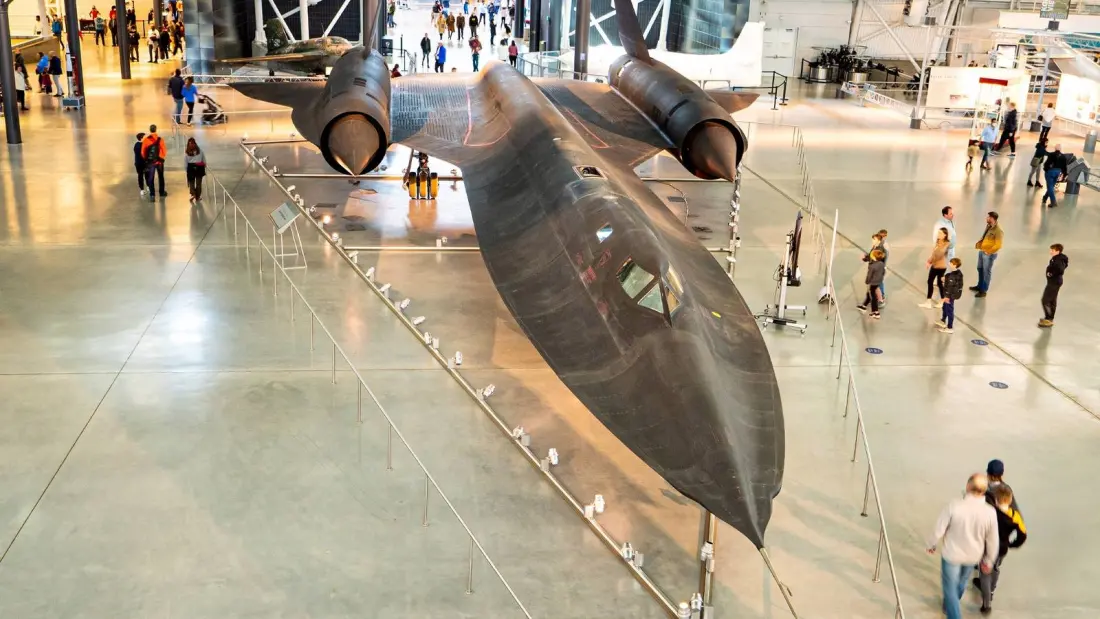
More than 25 years after it last flew, the Lockheed SR-71 Blackbird still holds the title of the fastest crewed, air-breathing aircraft ever in service — and a big part of the reason is an engine so strange that the people who maintained it called it 'black magic'.
The Pratt & Whitney J58 powered the Blackbird at a cruise speed of Mach 3.2, but it barely did the work you'd expect. At top speed, the engine itself produced only around 17% of total thrust. The rest came from air pressure dynamics inside the inlet nacelles, where giant forward-facing spikes controlled shockwaves and rammed air into the engine. Six curved bypass tubes bled hot air around the engine core and dumped it — still full of oxygen — into the afterburner, effectively turning the whole nacelle into a ramjet. Engineers never fully settled on how to classify the thing; it was formally labelled a 'Recovered Bleed-Air Turbojet', and the debate continues.
Everything about the plane broke convention. Air Force pilots were taught that afterburners were a 30-second emergency tool — the Blackbird demanded them lit for the entire mission. Counterintuitively, the faster it flew, the more fuel-efficient it became, burning less fuel per mile at Mach 3.2 than at Mach 2. On the ground it looked broken: built with loose tolerances so the titanium could expand safely at high temperatures, it visibly leaked its special JP-7 fuel while parked cold. That fuel was so hard to ignite that ground crews dropped lit matches into buckets of it to prove the point; the engines needed a chemical kick from triethylborane to light it at all.
The development story was nearly as extreme. Kelly Johnson's Skunk Works team at Lockheed had to invent new titanium metallurgy techniques and worked so closely with Pratt & Whitney — famously embedding himself at their Florida test stands — that the engine maker formed its own elite Skunk Works-style team just to keep up. Even refuelling required bespoke kit: a dedicated fleet of KC-135Q tankers carrying JP-7 and liquid nitrogen, with a special descent manoeuvre so the Blackbird, hovering near its stall speed at the tanker's max velocity, could stay plugged in.
Why should a traveller care? Because you can stand next to one. The final record-setting retirement flight in March 1990 delivered an SR-71 to the Smithsonian's National Air and Space Museum's Udvar-Hazy Center near Washington DC, where it hangs today alongside the Space Shuttle Discovery. Its records remain largely unbroken: 2,193 mph and 85,068 feet, set in July 1976, plus a coast-to-coast run of 64 minutes 20 seconds and a transatlantic crossing of just 1 hour 54 minutes that still stands after 50 years. For anyone drawn to the raw extremes of aviation engineering, this hangar is worth building a trip around.
Story based on reporting by Simple Flying.