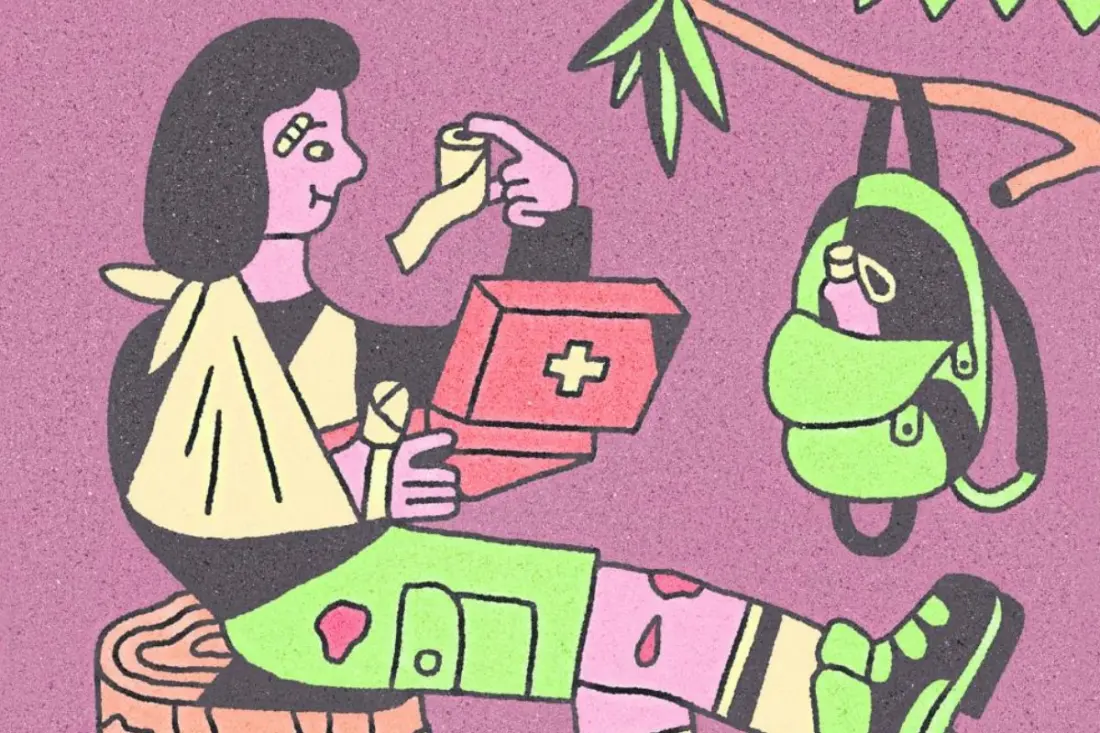
A commuter faints on a station platform, splits an eyebrow open on the concrete, and everyone freezes. Except one passenger with a portable first-aid kit who kneels down, asks the crowd if anyone has medical training, and stops the bleeding until a medic arrives. That scene is a good argument for packing your own kit rather than relying on strangers when you travel.
The story comes from a border and security guard turned emergency medical worker, whose kit has already paid for itself on flights, ferries and accidents. Here's what earns a spot.
A haemostatic gauze sits at the top of the list. Standard bandages handle scrapes, but arterial bleeding can be life-threatening within two minutes. Haemostatic gauze, packed into a deep wound, can stop even serious cuts quickly. Modern versions like the Emergency Bandage add a pressure bar and locking bar, plus a non-adhesive pad, so you can treat a major wound without tearing the dressing off painfully later. Pair it with fabric adhesive strips, which stay put better than most kit staples.
A quality torch matters more than you'd think — the keyring-sized BZ1T from Zweibrüder shines a beam over 20 metres, useful for assessing injuries, and in low-power mode it's bright enough to check someone's pupils for signs of allergic reaction or opioid poisoning. Instant ice packs aren't usually in off-the-shelf kits, but chemical cold packs ease headaches, back pain and burns; during a heatwave they can even help you sleep in an air-conditioning-less hotel. Just press one against a fan for the same effect as frozen water.
For incidents where clothing needs to come off fast, rescue trauma shears cut through most fabrics — leather included — and double as a splint-cutter and tangle-detangler. Tweezers round out the tools; note that Britain has some of the strictest blade laws, so check what's allowed on your flights.
A final word on the big stuff: only about 10% of out-of-hospital cardiac arrest victims survive. A pocket-sized semi-automatic defibrillator weighs roughly 700g — its battery and pads included — and retail versions cost around £999 in the UK. Expensive, yes, but worth considering if you explore remote areas or travel with someone who has a known heart condition.
The takeaway for any traveller: a modest, well-chosen kit turns you from a bystander into someone who can help. Factor in antiseptic wipes, tweezers, safety pins, a small scissors or multitool, blister plasters and oral rehydration sachets, and the whole thing fits in a pouch that takes up less space than a paperback.