
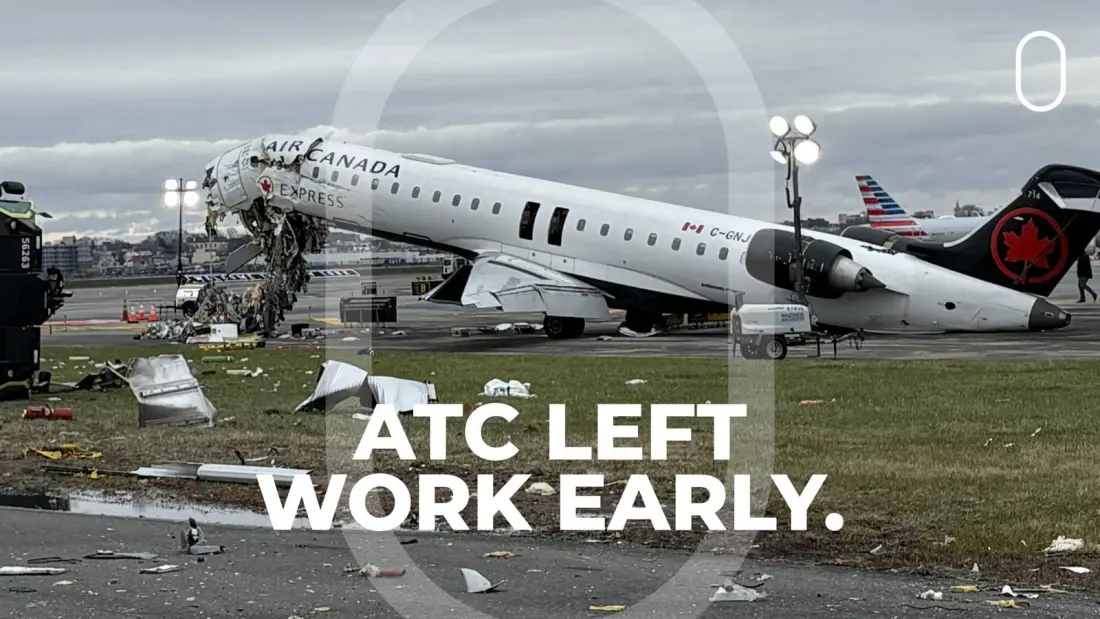
A new detail has emerged in one of the more disturbing aviation accidents of recent years. On March 22, 2026, an Air Canada Express regional jet collided with an airport fire truck that had driven onto the active runway as the aircraft was landing at New York LaGuardia. Both pilots of the CRJ were killed. Now, roughly five months on, a source familiar with the investigation has told media that two air traffic controllers in the LaGuardia tower reportedly left work early on the night of the crash — a claim that, if confirmed, would raise serious questions about staffing levels in the cab at the time of the accident.
The core facts of the incident were already grim: a commercial passenger jet on final approach, a rescue vehicle where it should never have been, and no way for the crew to avoid the collision. Runway incursions involving ground vehicles are rare but among the most dangerous scenarios in aviation, because a landing aircraft has essentially no ability to swerve or stop once committed to the runway. That's why airports run strict protocols governing exactly who can be on an active runway, when, and under whose clearance.
The reported early departures add a human-factors layer to the investigation. US air traffic control has been under strain for years — understaffed facilities, mandatory overtime, and fatigue-related concerns have all featured in recent safety reviews. If investigators find the tower was below required staffing when the fire truck entered the runway, the focus could shift from a single bad decision to a systemic staffing problem, with potential consequences for how controllers are scheduled at busy facilities nationwide.
It's worth remembering that this is a claim from an unnamed source, not an official finding. The NTSB's final report will be the authoritative account, and early details from anonymous sources don't always survive the investigative process. Still, for anyone who flies through New York regularly, the story is a reminder that the safety margin in aviation depends on a chain of people — controllers, drivers, dispatchers — all doing their jobs at the right time.
For travellers, there's no action to take here beyond awareness: the incident is a story about airport operations and oversight, not about a route or an aircraft type to avoid. Regional jets like the CRJ remain a workhorse of the North American network, and the loss of the two pilots is a reminder of who absorbs the risk when ground coordination breaks down. Expect the investigation, and any staffing policy fallout, to keep unfolding in the months ahead.