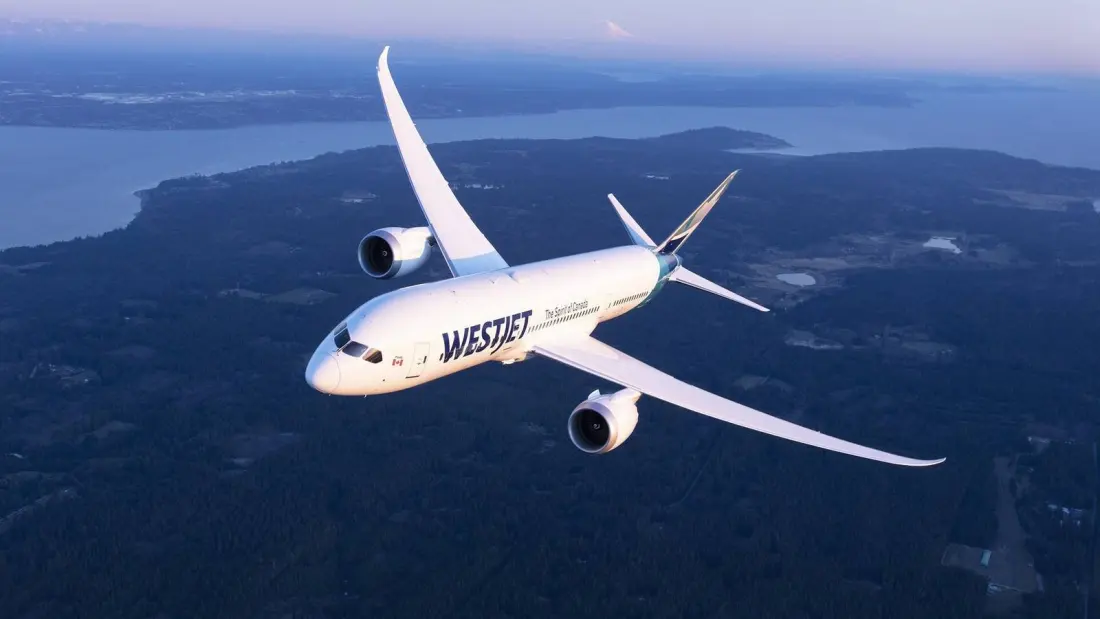
Calgary is about to gain a genuinely new long-haul option. On December 15, WestJet starts flying nonstop to São Paulo, the airline's first-ever South American route and the only direct passenger link between Western Canada and the continent. At 6,610 miles, it also becomes WestJet's longest route, overtaking Calgary–Seoul.
Flights run three times weekly on a 320-seat Boeing 787-9, the airline's only widebody, split into 16 Business, 28 Premium and 276 Economy seats. WS54 departs Calgary at 11:55 PM on Tuesdays, Thursdays and Sundays, landing in São Paulo at 3:45 PM the next day. The return leaves Guarulhos at 7:40 PM and reaches Calgary the following afternoon. São Paulo marks WestJet's 100th nonstop destination from its Calgary hub — a fourth continent added to a network that already stretches to Europe and Asia on the same Dreamliners.
Here's the odd part: the first season is remarkably short. What was originally planned as a five-month winter route from early November to mid-April has been trimmed to December 15 through February 14. The caution makes sense when you look at the numbers — only around 10,000 passengers flew between Calgary and São Paulo in 2025, a thin base for a 320-seat aircraft. WestJet is betting instead on connections: Vancouver accounts for roughly 42,000 São Paulo travellers, Seattle another 26,000, and Edmonton about 5,000, all of whom can now funnel through YYC. At the far end, an interline deal with LATAM (plus shared Delta ties) opens up more than 60 South American destinations on one itinerary, from Rio and Lima to Santiago and Buenos Aires.
There's a quirkier angle too. Calgary sits almost exactly on the shortest path between São Paulo and Tokyo — routing via YYC adds just 0.2% to the great-circle distance versus a hypothetical nonstop, and beats the popular Dubai routing by over 1,000 miles. With Brazil home to the largest Japanese diaspora in the world, the geography is tantalising. But the current timetable doesn't cooperate: connections between the São Paulo and Narita flights involve layovers of eight to eleven hours, so the Brazil–Japan gateway idea remains theoretical for now.
For travellers, this is a rare chance to reach Brazil from Western Canada without connecting through Toronto, the US or a Gulf hub. Snowbirds, business travellers with Brazilian ties, and anyone eyeing onward South America itineraries should book early — if the two-month trial doesn't fill seats, there's no guarantee the route returns next winter. Business class on a 787-9 on a brand-new route is also a nicer way to cross the equator than most alternatives.