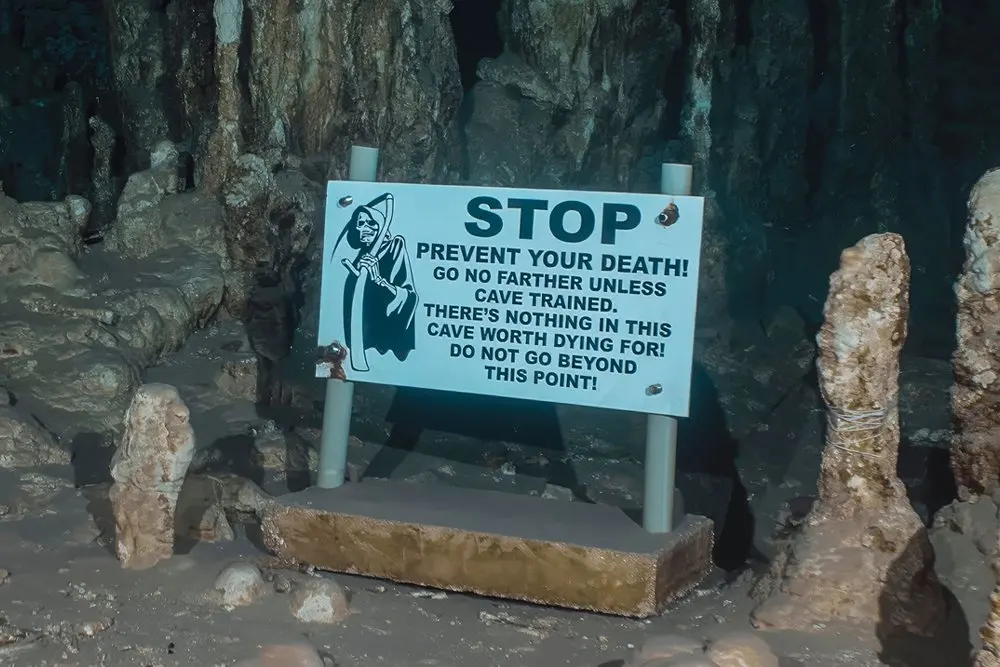
Six people died in a cave on Vaavu Atoll in the Maldives earlier this year: five Italian divers and a member of the Maldives armed forces. Four months on, no official findings have been published, but the picture emerging suggests the group pushed far beyond recreational diving limits — and paid the price.
The cave's entrance sits at roughly 50 metres, already deep for recreational gear on a single tank of air. The fatal mistake, according to reporting in Dive Magazine, appears to have been pressing on from there: a 20-metre tunnel leading into a second, deeper chamber, where four of the Italians were found at 60 metres. At that depth, margins are razor thin. Gas narcosis clouds judgement, air consumption spikes, and any wrinkle — a current, a gear fault, a moment of confusion — can turn serious fast.
What's striking is how normal this kind of rule-breaking is. A DAN Europe representative, Ramón Verdaguer, argued online that most long-time divers have exceeded their limits at some point, and the article's author admits to a 55-metre dive on a single tank in Croatia, where the guide treated going deep as routine. A DAN Europe presentation has since suggested the Vaavu Atoll cave itself was a regular stop for recreational divers.
Egypt's Blue Hole at Dahab tells the same story. Its arch, a tunnel about 25 metres long connecting the sinkhole to the open Red Sea at around 56 metres, looks deceptively easy in the clear water — but it's a technical dive requiring special gas mixes and proper planning. The memorial plaques on the cliff above the site are a blunt reminder of how often divers have misjudged it. And the problem compounds: get away with descending to 50 metres, and it feels reasonable to push a little further. That's exactly where things unravel, the diving equivalent of speeding past a blind bend you've survived a hundred times.
For holiday divers, the takeaway is practical rather than preachy. Recreational limits — generally 18 metres for entry-level divers, 40 metres for deep speciality training — aren't arbitrary. They're conservative by design, built on decades of incident data. If a guide on a tropical trip casually offers to take you deeper than your certification, that's a question, not a privilege. And if you want caves, wrecks beyond 40 metres or penetrations like the Dahab arch, the route in is proper technical training and mixed gases, not bravado. The divers who die, as the article notes, are often experienced enough to feel confident but not experienced enough to be right.
Even if you never go near a deep cave, this matters when choosing dive operators and destinations. Ask what depths a guided dive actually involves, whether the site has a history of limit-pushing, and how the outfit handles deep stops and gas planning. Vaavu Atoll remains one of the Maldives' best diving areas — channels, sharks and hammerheads — but its caves belong to trained technical divers.