
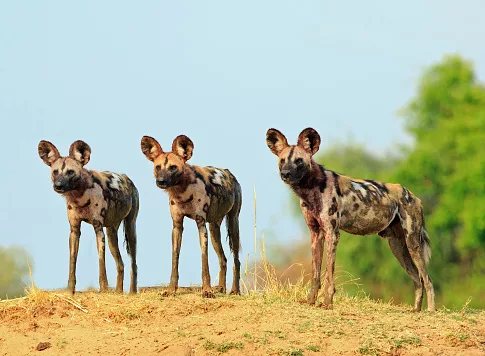
Three male African wild dogs from Zambia have covered 4,126km in nine months — roughly the distance from Cairo to Cape Town — and in doing so set a record researchers call the longest movement ever documented in an African mammal.
The trio, dubbed the Mayukuyuku males, left their birth pack in Kafue National Park in mid-2025 and headed east before turning north towards the Copperbelt cities of Kitwe and Ndola. They then looped back and pushed east again, eventually reaching the Luangwa River Valley, which supports a wild dog population of around 400. By April 2026 they had settled in a game management area between South Luangwa and Lower Zambezi national parks, where researchers from the Zambian Carnivore Programme suspect they may have claimed new territory and joined a pack.
The findings come from a GPS-collaring study tracking 19 wild dog groups across and around seven Zambian national parks. Four of those groups strayed to within a few kilometres of Zambia's borders with Angola, the Democratic Republic of Congo, Malawi and Zimbabwe. Similar epic movements have been logged in Botswana, Tanzania and Zimbabwe, suggesting wild dog populations across Southern and Eastern Africa are more connected than scientists had assumed — a big deal for an endangered species that needs genetic exchange and new mates to survive.
There's a sobering side too. A female tracked in 2021 covered more than 2,300km after leaving South Luangwa with her sisters, only to die in a wire snare in southern Zambia. Snares set for bushmeat are especially lethal for wild dogs because pack members linger near an injured companion, sometimes resulting in several deaths from a single trap.
Why does this matter to travellers? Because the corridors these dogs depend on overlap with some of Africa's finest safari country — Kafue, South Luangwa and Lower Zambezi, plus the wider Kavango-Zambezi Transfrontier Conservation Area linking Zambia, Zimbabwe, Botswana, Namibia and Angola. Conservationists argue that tourism revenue gives communities a reason to keep those linkages open. "We don't need to separate people from nature," says Zambian Carnivore Programme chief executive Matt Becker, pointing to nature-based tourism and legal game ranching as ways to make connected landscapes pay.
In short: every safari booking in these parks helps bankroll the very connectivity that let three determined dogs cross a country. Few wildlife sightings beat a painted dog pack on the move, and Zambia remains one of the best — and least crowded — places to try for one.