
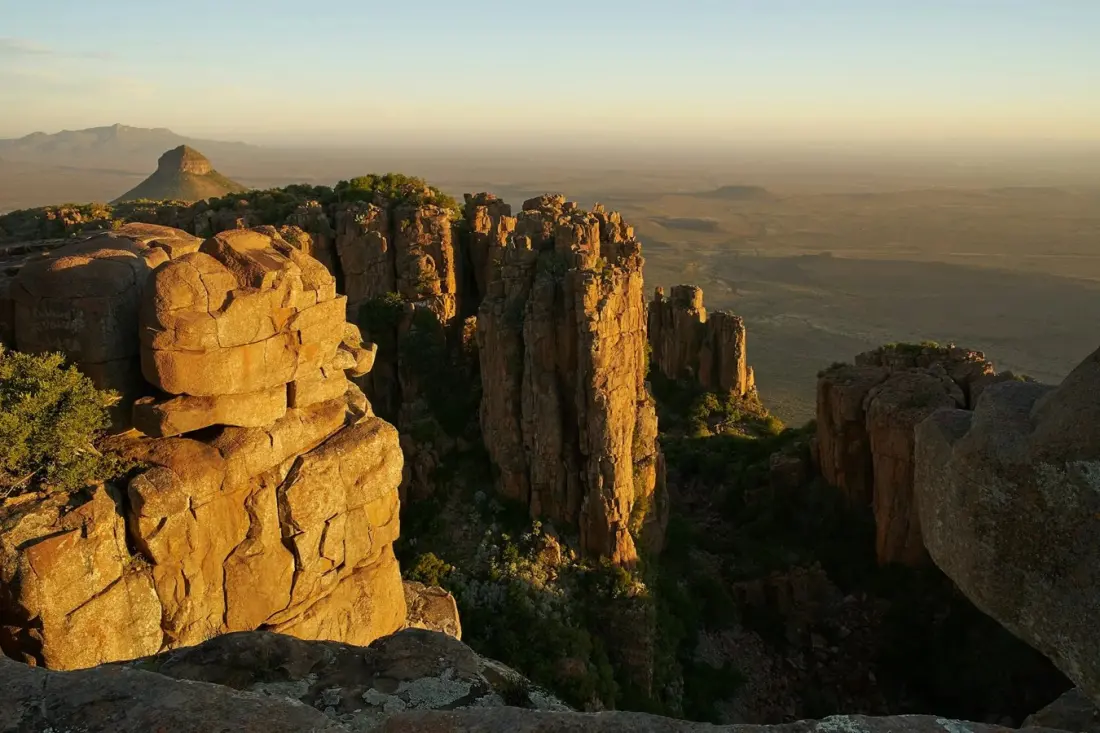
Above the town of Graaff-Reinet in the Eastern Cape, a cluster of towering dolerite columns drops away to the endless plains of the Great Karoo. This is the Valley of Desolation, part of Camdeboo National Park and one of South Africa's most dramatic geological sights — and, unusually for a landmark this grand, one you don't need to be a serious hiker to reach.
The story in the rock is ancient. Around 200 million years ago, during the Jurassic Period, molten magma pushed into layers of sedimentary rock and cooled underground as dolerite. Over millions of years, erosion stripped away the softer rock around it, leaving the sheer vertical pillars that stand today — a formation so imposing it's nicknamed the "Cathedral of Mountains". The process hasn't stopped; the landscape is still being shaped.
Access is refreshingly easy. A road climbs to the top, with viewpoints along the way, and from the parking area the Crag Lizard Trail covers about 1.5 km in roughly 45 minutes, passing the main overlooks. It's a short walk, but photographers will want far longer: the scenery shifts noticeably with the light, so early morning and late afternoon pay dividends. From the viewpoints, the dolerite cliffs fill the foreground while Graaff-Reinet and the Karoo plains shrink below.
There's human history here too, and plenty of it. Camdeboo National Park holds Stone Age tools — hand axes, grinding stones — and rock paintings from later hunter-gatherer communities. The Inqua people occupied the wider area in the mid-1600s, and white farmers settled the Camdeboo Plains and Sneeuberg from around 1770.
The conservation story is just as interesting. The Valley was declared a national monument in 1939, and in the 1970s a national push to protect the Karoo gained ground — helped by a charming campaign in which roughly 300,000 schoolchildren across South Africa bought symbolic pieces of the proposed reserve. The Karoo Nature Reserve was handed over in 1976 and eventually became part of Camdeboo National Park, proclaimed in 2005 and now covering about 19,405 hectares. Even the access road has heritage credentials: built with picks, shovels and dynamite, finished in 1930 for around R2,000, and tarred in 1978.
For travellers, the appeal is obvious: a world-class view that costs you less than an hour of walking, wrapped in a landscape that tells a story from the Jurassic to the Stone Age to South Africa's conservation movement. It works as a quick stop on a Karoo road trip or as the centrepiece of a Graaff-Reinet weekend, and it's a fitting outing for Heritage Month, when the park's layered past feels especially relevant. Bring a camera — but expect to put it down and just look for a while.