
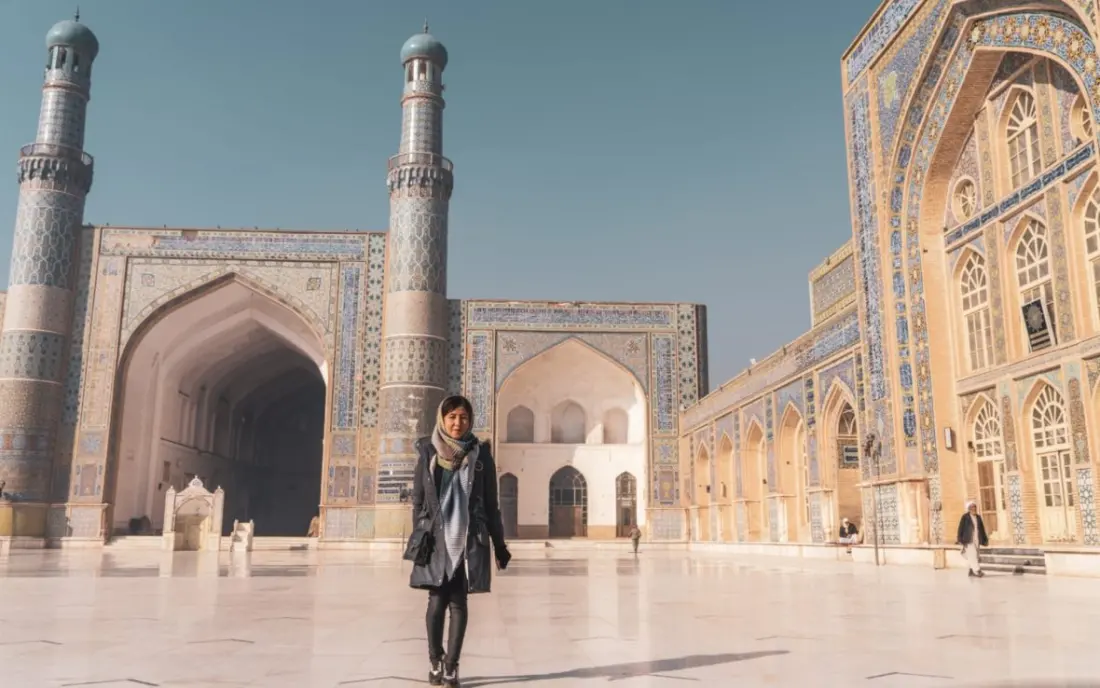
Fatima Haidari's office is a Zoom call. Her subject is Herat, the western Afghan city she grew up beside — its 15th-century mosque, its Silk Road bazaar, its turquoise minarets — and she narrates it all from exile in Milan. The 27-year-old was Afghanistan's first female tour guide. Now, five years after fleeing the Taliban, she runs virtual tours of the country she can't safely re-enter.
Her route into guiding was accidental. A Facebook page she started to share Afghanistan's 6,000-year history caught the eye of a Ukrainian traveller, who booked her for a tour of Herat and passed her name to British adventure company Untamed Borders. Alongside guiding, she studied journalism, hosted a radio show called 'Winner Women', and taught English and maths to local women.
All of that ended in August 2021. Within a month of the Taliban's return, girls were barred from secondary school; more than 100 decrees since have stripped women of work, money, education and public life. Haidari — by then internationally known after CNN coverage of her guiding — burned her documents and joined the desperate crowds at Kabul airport before reaching Italy. She has since completed a degree at Milan's Bocconi University and is starting a Master's in International Law.
The virtual tours themselves mix drone footage and photographs as she talks visitors through Herat's highlights: the Musalla of Gawhar Shah, built after Queen Gawhar Shad moved the Timurid capital from Samarkand in 1405; the 13th-century bazaar where families spend two years weaving silk carpets; the poetry of Rumi, born in Balkh, which Haidari calls 'a way of life' for Afghans. Tea, she notes, is never offered — only asked black or green, with cardamom or saffron.
A share of her tour earnings funds a secret school inside Afghanistan, where girls are banned from education after age 12. It has grown from one teacher to four English teachers, a tailor teaching women to sew for income, literacy classes for older women, and workshops on rights and mental health. 'It's not just a classroom, but a way of resistance,' she says.
There's an uncomfortable wrinkle for would-be visitors: Afghanistan launched 30-day e-visas in March 2026 (USD$128, open to most nationalities), making paperwork easier than before. But the UK Foreign Office and US State Department both advise against all travel, and the country ranks 157th of 163 on the 2026 Global Peace Index. UN Women calls the situation there 'the most severe women's rights crisis in the world'. This is not a destination to book a flight to — which is precisely why these tours matter. They offer a way to meet Afghanistan, and Afghan women's reality, without endorsing the regime or risking lives. The writer of the original piece says she'd rather wait than join the 'Talibros' influencers; Haidari's screenside tours are the alternative worth supporting.