
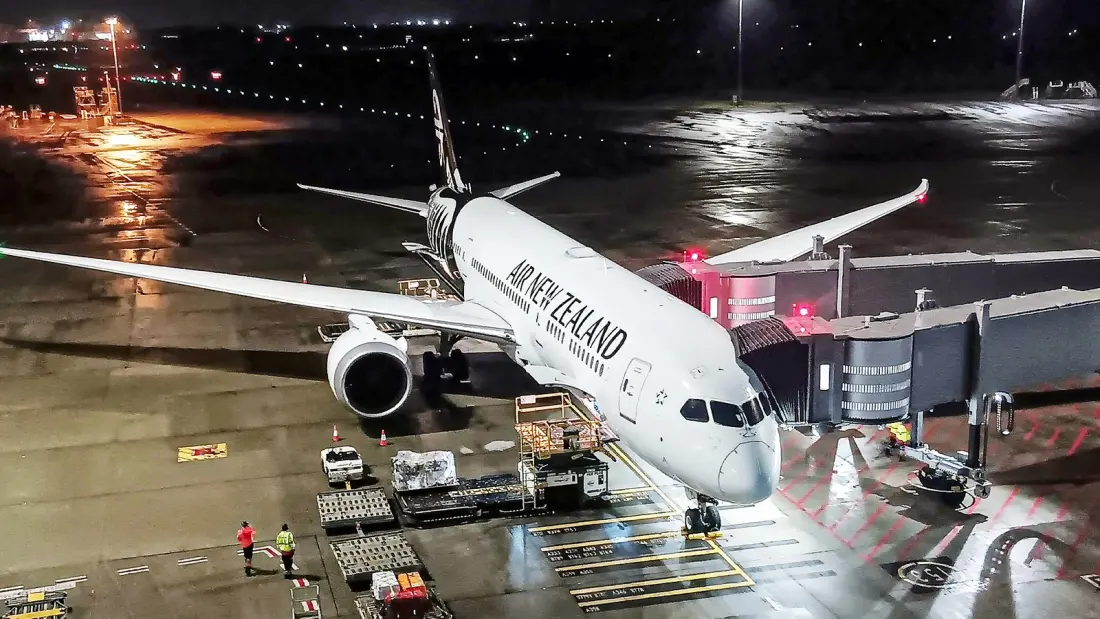
Air New Zealand's long engine saga is finally over. Its last grounded Boeing 787-9, registered ZK-NZD, left storage in the Australian outback in late June after nearly nine months parked at Alice Springs, and it's already back on international routes — its first commercial flight was the Auckland–San Francisco service on June 30.
The aircraft had been stored since September 12, 2025 while the airline dealt with ongoing problems with its Rolls-Royce Trent 1000 engines, which have plagued the global 787 fleet since 2016. That's when All Nippon Airways discovered fatigue cracking in intermediate-pressure turbine blades, triggered by high-temperature corrosion. Further issues with compressor and high-pressure turbine blades followed, forcing inspection intervals to shrink from every 200 flights to as few as 80 by 2018. The resulting engine shortage grounded 787s worldwide — at the worst point, five of Air New Zealand's 14 Dreamliners were out of action.
The workaround was costly. Air New Zealand leased two Airbus A350-1000s and later wet-leased a Cathay Pacific Boeing 777-300ER for three years. Engine troubles, including the Trent 1000 and Pratt & Whitney's PW1100G, cost the airline roughly NZ$190 million in earnings impact in the first half of 2026, with another NZ$70–90 million headwind expected this year.
Now the focus shifts to growth. Two more 787-9s — notably powered by the rival GE GEnx engine, which now equips about two-thirds of the world's 787s — arrive by the end of 2026, and the cabin retrofit programme (new Business Premier, Premium Economy and updated Economy) finishes across the fleet by year's end.
For travellers, the payoff is new long-haul options from Christchurch. The airline is reviving its Singapore route from October 28 after a six-year gap, resuming Perth flights from November 30, and — the headline act — launching a brand-new non-stop service to Tokyo Narita from November 26. All three run three times weekly through the southern summer. Ten Dreamliners in total are on the way, so more capacity and route announcements look likely.
If you've been waiting for direct South Island departures to Asia or Japan, this is the summer to book.