
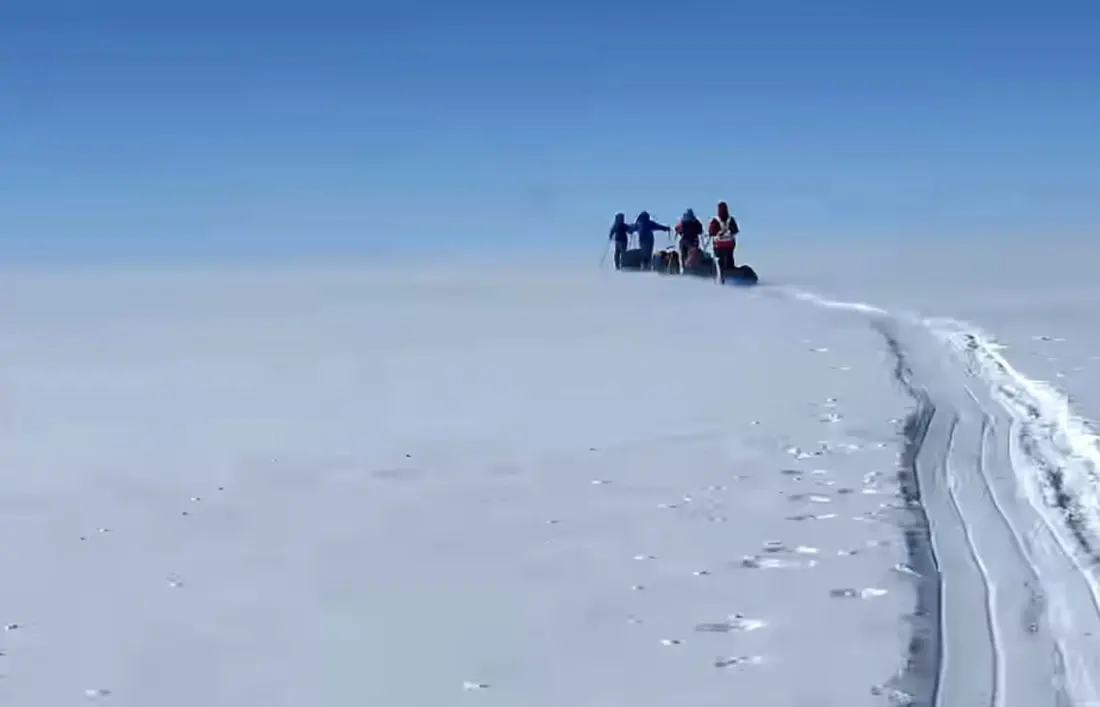
Greenland's ice cap is usually a late-spring project, but this year the summer season produced its own stories. Two teams crossed the ice sheet east to west in August and September, proof that the classic route works outside the busy May window.
The first was a commercial trip from guiding company Ousland-Colliard, led by Angus Staples. Staples and four clients flew to Tasiilaq, the largest town in East Greenland, and set off on August 15. The opening days were the messy part: crevassed terrain, knee-deep river crossings and ridges of ice over a metre tall before the ground steadied. On one day they hit a river system too wide to cross and had to wait, then ferry the sleds over the channels one by one.
Once on skis, the grind began — about 20km a day in ten-hour shifts in fine weather. They topped out at 2,500m on day 19, the high point of the route, where Staples noted the change ahead: tailwinds instead of headwinds, and no more uphill. The descent brought faster days, including 30km stretches, and a stop at DYE-2, the eerie abandoned Cold War radar station that sits on the ice and doubles as every crosser's favourite mid-route landmark. After 32 days they rolled into Point 660, where a gravel road links the ice edge to the airport at Kangerlussuaq — the standard finish line.
The second crossing had a more historic flavour. An eight-strong team from the UK armed forces, led by Tony Lancashire, followed a variation on Fridtjof Nansen's original 1888 route — the first ever crossing of the ice cap. Part of the team even sailed from Norway to Iceland and on to Greenland before starting on foot. They began at Nansen's landing point in Umivik Bay, crossed the sheet, dropped through the Austmannadalen nature reserve and finished at Ameralik Fiord, where a boat took them to Nuuk. Their route ran 666km in 30 days, a fair bit longer than the standard line.
Why does this matter if you're not hauling a sled? Because Greenland's summer season is quietly viable. Most crossings cluster in May, when flights to the east coast can be shared by several expeditions; August offers solitude, milder temperatures and meltwater scenery — rivers, marshy ice and open approaches — that spring travellers never see. The trade-off is real, though: crevasses and water obstacles near the eastern margin make the early days trickier, and you'll want solid glacier skills or a guide. For most travellers, the practical takeaway is simpler — Kangerlussuaq and Point 660 are reachable by road and flight, and DYE-2 can be visited on shorter ice-cap trips, giving a taste of this world without a month-long expedition.