
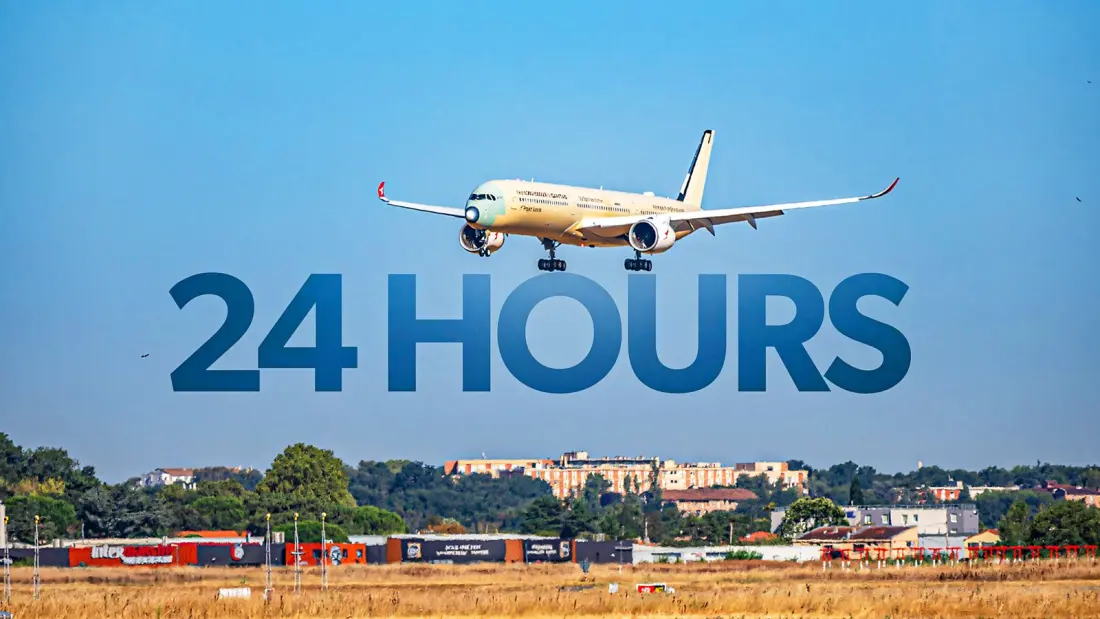
A commercial aircraft has never flown further without landing. In late July, an Airbus A350-1000ULR took off from Melbourne just after dawn on the 27th and touched down in Toulouse a day and 24 minutes later, covering 12,460 nautical miles — about 23,076 km — and setting a new distance record for a nonstop commercial jet flight. The route crossed three continents, two oceans and 17 time zones, passing over Sydney Kingsford Smith Airport along the way.
This wasn't a stunt. It was a certification test for Qantas' Project Sunrise, the airline's plan to fly Sydney–London nonstop from October 2027, cutting roughly four hours off today's one-stop journeys. The purpose-built A350-1000ULR adds a 20,000-litre rear fuel tank and weight-saving tweaks to an aircraft that already ranges around 9,100 nautical miles in standard form. The Melbourne–Toulouse run proved the extra tank, pumps and gauges work in practice, and that the jet can handle the roughly 23-hour block time with margin to spare for diversions — reassuring news for Qantas, which has ordered just 12 of the type.
The flight also underlines how far Airbus has pulled ahead of Boeing at the extreme end of long-haul flying. Boeing's 777X, ordered back in 2013 and originally due in 2020, still hasn't been certified — the expectation now is the first half of 2027, with commercial launches tipped for early the following year. Frustrated early customers Lufthansa and Emirates have even said they'll refuse some aircraft built years ago while waiting for approval. When the 777-8 does arrive, its 9,500-nautical-mile range will beat the standard A350s, and its sheer size — up to 425 seats in two classes — will give Boeing a capacity edge. But the A350-1000ULR has already claimed the range crown before the 777X has even entered service.
Airbus isn't stopping there. Rolls-Royce, the A350's sole engine supplier, has hinted a decision on a stretched A350 variant could come within 12 months, potentially with deliveries in the early 2030s. The A350 programme has 734 of 1,624 ordered aircraft delivered as of August, so the platform has plenty of momentum.
For travellers, the headline takeaway is simple: from late 2027, the world's longest flights — Sydney to London, and potentially others of that scale — will be a reality, and they'll be flown on Airbus metal. Four hours saved on one of the most exhausting routes in aviation is a meaningful shift, and competition in the ultra-long-haul space should keep airlines honest on comfort and pricing as more of these routes launch.