
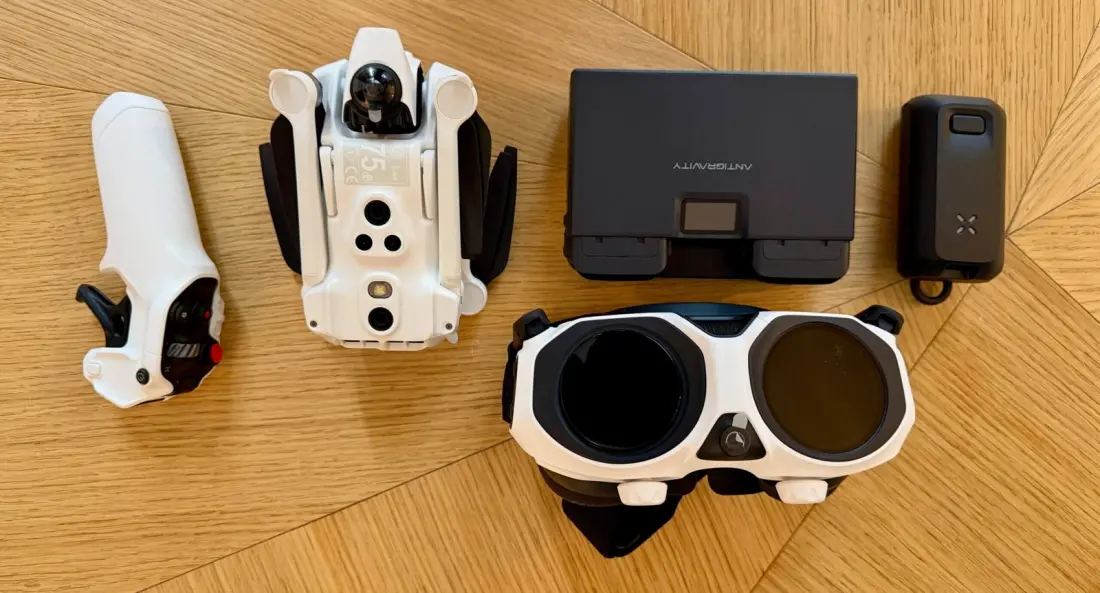
Most travel drones make you fly carefully, line up a shot, and hope you nailed it before the battery dies. The Antigravity A1, a 360-degree drone released in late 2025, throws that workflow out. It records everything in every direction at once, so you pick your angles afterwards — a "fly now, frame later" approach that turns a flight into a shoot-anything mission.
The trick is in the hardware. Instead of one forward-facing lens, the A1 has two ultra-wide 200-degree lenses, one above and one below the body. Stitched together, they form a full sphere — and in the exported footage the drone is digitally erased, so it looks like a camera floating invisibly in mid-air. That invisible-drone effect is exactly what travel vloggers have been chasing for years. The 1/1.28-inch CMOS sensors aren't cinema-grade, but they're much bigger than typical 360 action cameras, which helps in low light and harsh midday contrast. Footage handles 20mph winds with gimbal-like steadiness thanks to the company's FlowState stabilisation.
Flying it is refreshingly simple. A one-handed motion controller means you point where you want to go and pull a trigger; tilt to bank, raise to climb. Reviewers note novices get comfortable within minutes, and the bundled goggles — dual 4K micro-OLED displays at 120Hz with head tracking — let you literally look around the recording in real time, turning your head to pan the view. There's also a "Turtle Mode" that flips the drone upright if you crash it, saving a long walk to retrieve it.
Practical travel details matter here too. The A1 weighs exactly 249 grams with its standard battery, slipping just under the 250g threshold that triggers registration requirements in most countries. Folded, it's roughly the size of a thick smartphone, so it genuinely fits in a daypack. The compromises: real-world battery life is closer to 19-20 minutes than the advertised 24 (a Pro Battery stretches to 39 minutes but pushes it over the weight limit), top speed is a modest 36mph, and the lenses are delicate.
Editing happens in the Antigravity Studio app, which pulls footage wirelessly at up to 80MB/s and lets you reframe by moving your phone around like a virtual camera. An AI Auto-Frame tool tracks subjects and cuts the shot for you — useful if you're a solo creator with no second pair of hands.
Who should actually buy one? Skiers, surfers and mountain bikers get the most obvious win: ActiveTrack plus 360 capture means the drone can't lose you, even mid-turn or underneath it. Real estate and interior shooters get seamless fly-throughs where every wall and ceiling is already recorded. And travel vloggers get broadcast-looking aerials without a crew or hours of re-flighting. It won't match a high-end cinema drone on image quality, but for anyone bored of the same old drone shots, the creative freedom is hard to argue with.