
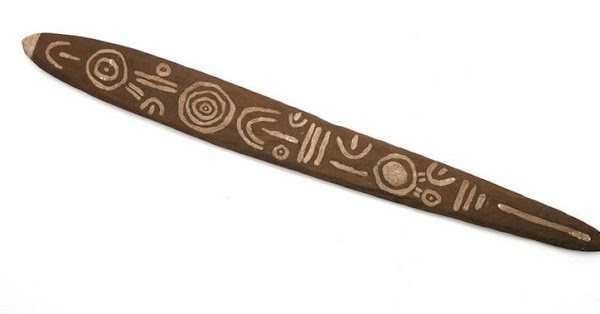
Long before emails or even postage, Aboriginal communities across Australia were running a working communications network across thousands of kilometres. The technology? Small carved wooden objects called message sticks.
A message stick is typically a piece of wood between a few centimetres and just over thirty centimetres long, incised with notches, lines, dots and geometric patterns, sometimes coated in ochre. The carvings weren't a script. Instead, they worked like memory aids — prompts that helped a messenger accurately relay an oral message, plus proof that the messenger was genuine. On arrival, the recipient would inspect the stick and hear the spoken message that went with it.
Because Australia's hundreds of languages and dialects made verbal communication between neighbouring groups unreliable, the physical object did the trust-building. It mattered less what the marks literally said than who sent it and that the messenger carried it openly. Notably, a few sticks have been interpreted successfully with no messenger present — for instance when a courier died on the way — so the carvings were not entirely meaningless on their own.
The most common reason to send one was an invitation. Ceremonies, initiation rites, marriages and big seasonal gatherings often drew people from far-flung communities, and a message stick was the formal invitation. They also handled diplomacy: requests for help, announcements of major events, and messages intended to keep the peace between groups.
European settlers were fascinated when they came across message sticks in the 19th century. Scholars in Australia and Europe spent years trying to decode the markings as a secret Indigenous writing system, before conceding the symbols don't encode language in any consistent way — each group had its own conventions, readable only within its cultural context. The debate continues in gentler form today: some researchers class message sticks as a limited kind of graphic communication, others say they fall somewhere between art, symbolism and writing. Projects like the Australian Message Stick Archive have pushed back hard on the old colonial assumption that Aboriginal societies had no sophisticated means of transmitting information. They plainly did — one built on social networks, geography and collective memory rather than an alphabet.
For travellers, this is a good reason to look past the rock art and didgeridoos in Australian museum collections and hunt out the message sticks. Institutions such as the South Australian Museum and the British Museum hold examples, and contemporary Aboriginal cultural centres and guided tours increasingly explain how these communication systems worked. Understanding them reframes the whole idea of pre-colonial Australia: a continent linked by couriers who might walk for days or weeks carrying a carved stick and a memorised speech.
Why care? Because the message stick is a reminder that 'writing' isn't the only way to build a long-distance information network — and one of the world's oldest such systems belongs to the world's oldest continuous cultures, right where you'd be travelling.