
Buried somewhere near Bedford County, Virginia — or so the legend goes — sits a vault of gold, silver and jewels worth tens of millions of dollars. The only clue to its location is an encrypted message that has defeated codebreakers for well over a century.
The story surfaced in 1885 through a pamphlet called The Beale Papers. It claimed that in 1817 a Virginian named Thomas J. Beale led roughly thirty men west on a buffalo hunt, stumbled on a rich gold and silver deposit near present-day Colorado or New Mexico, and hauled shipments back east in 1819 and 1821, burying them in a stone-lined vault six feet underground. Beale handed a locked iron box of three ciphers to Lynchburg innkeeper Robert Morriss, promising a key that never came.
When Morriss finally opened the box decades later, only one of the three messages could be cracked — by an unnamed friend who used the Declaration of Independence as a book-code key. The decoded text describes the haul in detail: over 2,900 pounds of gold across two deposits, thousands of pounds of silver, and jewels traded in St. Louis, all packed in clay pots with iron covers. Cipher No. 1 supposedly gives the vault's exact location; No. 3 lists the owners. Neither has ever been solved, despite attempts using the Magna Carta, the Bible and the U.S. Constitution as keys.
Sceptics have plenty of ammunition. No historical record confirms Beale ever existed, and everything known traces back to the 1885 pamphlet, published by one James B. Ward — who charged 50 cents a copy. Statisticians have found oddities too: applying the Declaration key to the first cipher produces impossible alphabetical runs, and the number patterns in the unsolved texts don't behave like genuine encrypted English. There's even an Edgar Allan Poe theory, since Poe dabbled in ciphers and lived in Richmond in the 1820s, though it's been debunked — he died in 1849 and the pamphlet references the Civil War.
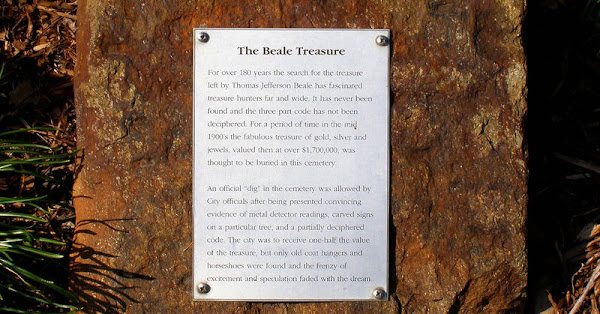
So why should a traveller care? Because Bedford County has absorbed the legend all the same. Treasure hunters combed its hills well into the 1990s, and a dig was even officially authorised at Lynchburg's Old City Cemetery, where a plaque marks the spot today. Whether you read the ciphers as a fortune or history's most profitable marketing stunt, the trail — Morriss's Lynchburg, the Bedford countryside, the puzzle itself — makes for an unusual road trip through Virginia's Blue Ridge foothills. Just don't bring a shovel. Countless people have, and none of them got rich.