
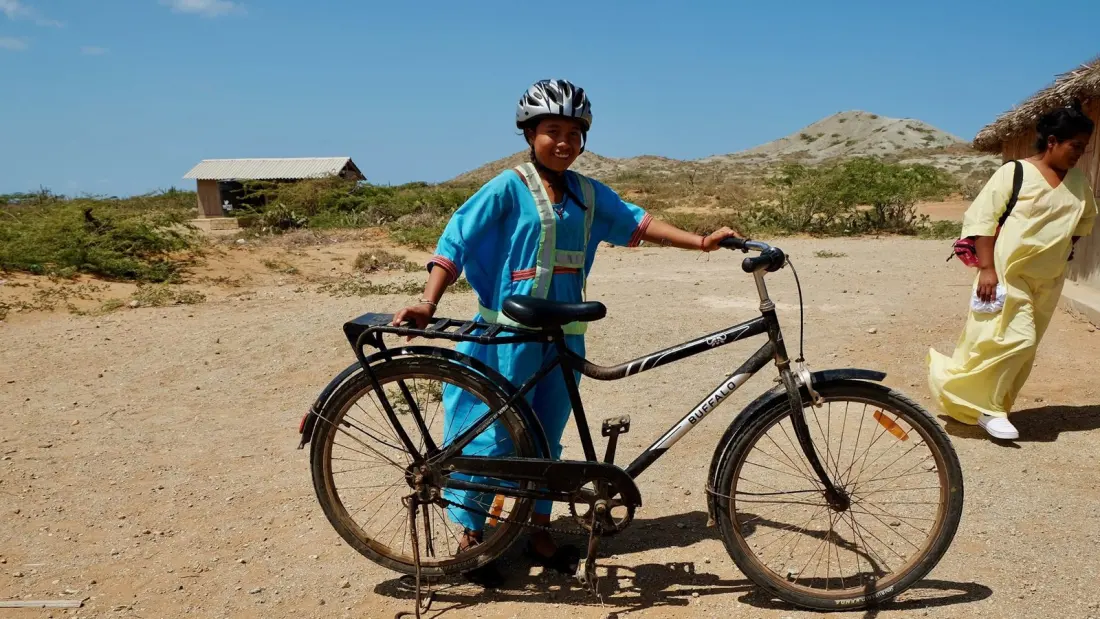
Every afternoon in a tiny coastal village on Colombia's northern tip, 14-year-old Ani Paola pedals her bike across the desert to the beach. There she sells handwoven mochila bags to kitesurfers and tourists, practises her English, and lately has been picking the brains of visiting marine biologists — her dream career. None of it would be possible without the Buffalo Bicycle she rides.
Ani Paola is Wayuu, the largest Indigenous group in Colombia, from La Guajira — a windswept desert peninsula roughly the size of Wales, where golden dunes meet turquoise water. Girls here learn to weave ancestral patterns from their grandmothers from as young as eight; the mochila bag carries deep symbolism, representing the womb. But the region is also among Colombia's poorest: government data from 2024 put 39% of its largely Indigenous population in multi-dimensional poverty, and a drying climate is shrinking the traditional wells (jagueys) families depend on. Tankered water costs around 70,000 pesos (USD 20) a week — out of reach for many. When water runs short, girls are the first pulled from school to fetch it.
That's where the bicycles come in. World Bicycle Relief, a charity partnered with The Intrepid Foundation, has distributed 53,000 Buffalo Bicycles in Colombia since 2020. The bikes are built for harsh conditions — double chains, a two-speed freewheel instead of gears, and aluminium frames that resist the salty coastal air. In 2025, 105 bikes arrived at one desert school; another 50 followed in March. Around 70% go to women and girls. The payoff is measurable: WBR estimates each bike supports a household of five and lifts average income by 43%, hauling loads of up to 100kg of fish, firewood or handicrafts.
The change shows up in daily life. A mother named Yamileth, who lives two hours from the school, used to arrive last and exhausted on foot; now the family cycles there in an hour, early and with energy to study. WBR also runs maintenance and life-skills classes, using care of the bike to teach kids about safety, consent and the environment — no small thing in a region where child marriage rates are among Colombia's highest and teen pregnancies roughly double the national average.
For travellers, the story adds texture to a region already gaining a name for kitesurfing and raw, otherworldly scenery. The Wayuu are matriarchal, and here the old taboos about women cycling never took hold — visit and you'll spot Buffalo bikes across the sand, mostly ridden by women. If you go, buying a mochila directly from a weaver like Ani Paola puts money where it matters most.
Why it matters: this is a reminder that a holiday destination is also someone's home, and that small, practical interventions — two wheels, a sturdy frame — can tip a girl's odds of staying in school. Travellers who want to help can donate to World Bicycle Relief through The Intrepid Foundation.
Story via Intrepid Travel Blog.