
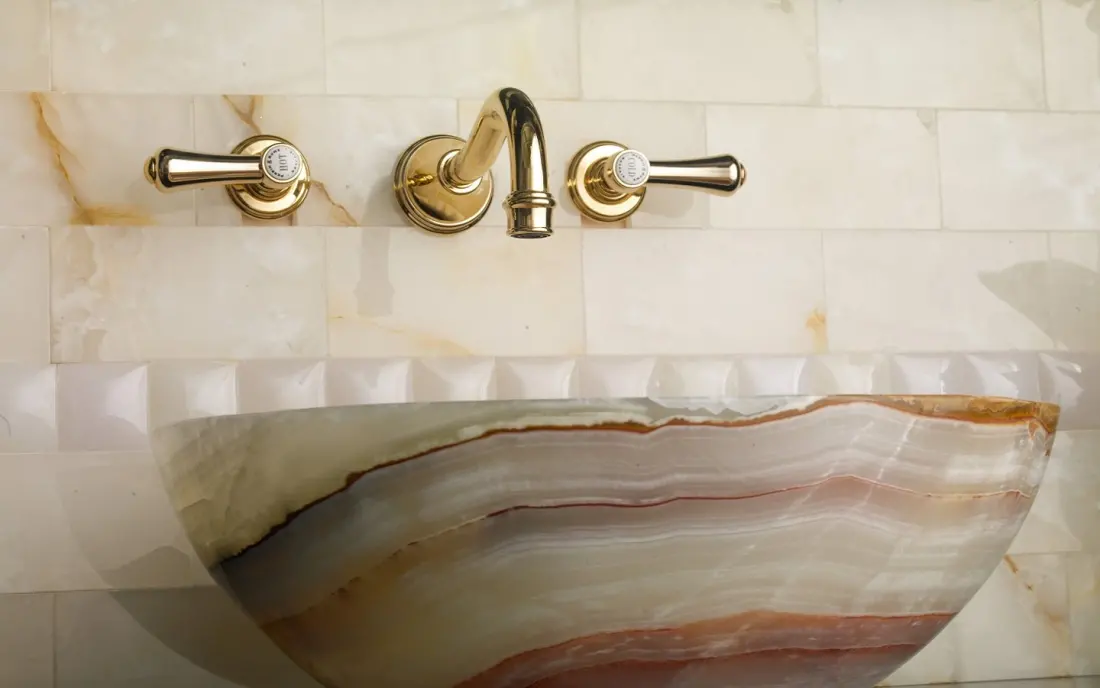
Chrome looks dated, steel fades into the background, and brass has been doing the job for five thousand years. That's the argument four hotel designers made in a recent roundtable with House of Rohl, whose brassware brand Perrin & Rowe has been sand-casting fittings since 1978.
The designers — Christine Skaar of KVIST, Marie Soliman of Bergman Design House, Jason Stewart of Rigby & Rigby and Jill Higgins of Studio Jill — traced the metal's arc from Egyptian royal jewellery to Birmingham foundries to the grand hotels that followed: the Waldorf Astoria, the Mandarin Oriental, and countless panelled bars since. For Soliman, brass meant craftsmanship and permanence long before it meant style.
What keeps it in modern spec sheets is how it behaves. Solid brass doesn't wear out — it develops a patina, so it ages with the building rather than against it. Skaar treats its finishes as a palette: aged and unlacquered reads honest and weighty, brushed feels crisp and contemporary, polished catches the light, blackened turns architectural. Her approach is to use one metal across a whole scheme, shifting the finish room by room rather than mixing metals.
It's commercially proven too. At Nammos, Rigby & Rigby's Mayfair restaurant, brass signage sets the tone at the door and detailing at the bar plays against timber cladding and woven rope. Stewart calls brass a 'hero finish' with historical status that silver tones rarely match.
The catch, all the designers agree, is that brass only reads as luxury when it's solid. Cheap brass-effect coatings have damaged the metal's reputation, but the difference is obvious the moment you lift a real fitting — weight, mechanics, hand-finished detailing. And since taps, handles and thresholds are among the few surfaces guests actually touch every day, solid brass performs better immediately and keeps improving with use.
The theory is on show at Fowey Hall, a country house hotel above the estuary on Cornwall's south coast, recently refurbished by Studio Jill. Rather than over-styling a building already rich in cornicing and panelling, the team layered antique and contemporary pieces and let freestanding Victoria + Albert baths do the quiet work: the Monaco in bold colourways for the modern wing, the deep Victorian claw-foot Cheshire anchoring the original house. Higgins calls it 'understated luxury with an attention to detail.'
For travellers, this is more than design-chat. Brass is the detail you feel without noticing — the weight of a tap, the glow of a bar sign — and a good indicator that a hotel spent money where it counts rather than on surface gloss. A material that reads heritage in Cornwall and nightlife glamour in Mayfair is doing serious work, and it's worth knowing how to spot the real thing on your next stay.