
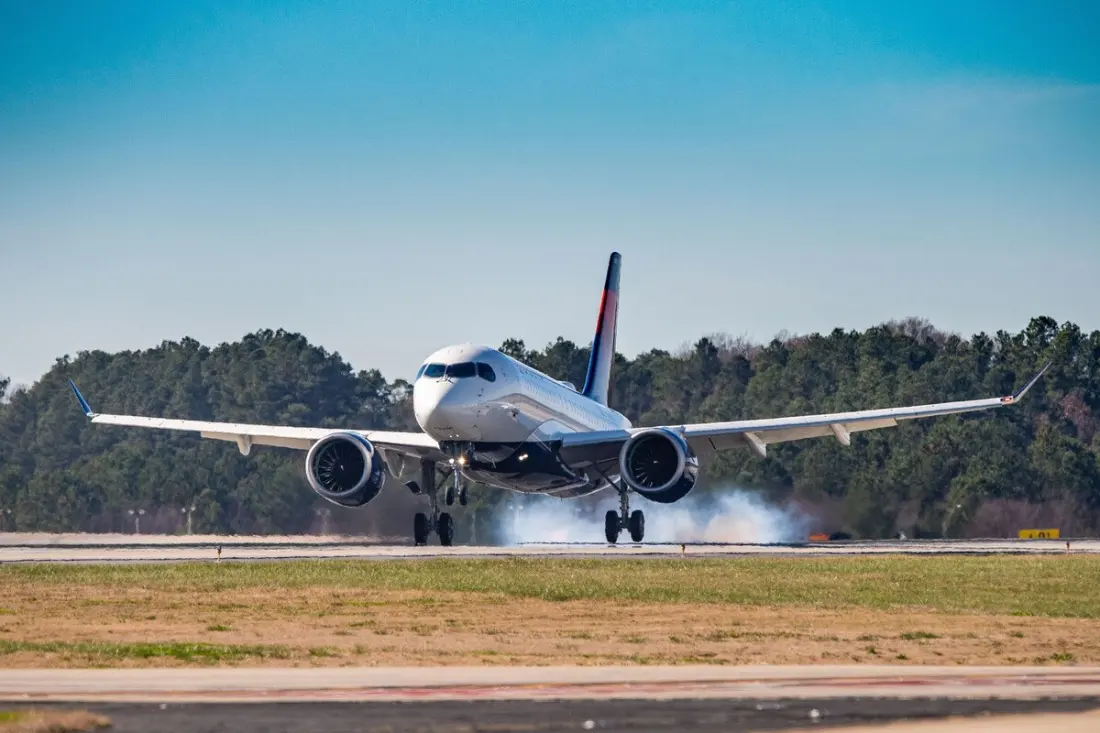
Thirteen Airbus A220s registered in the United States are the subject of a new FAA proposal covering a flexible fuel hose inside the wing. The jets belong to Delta, JetBlue and Breeze — the three airlines that have made the A220 a fixture on short and medium-haul US routes. Unlike the engine troubles that have dogged the type for the past two years, this one looks like routine preventive maintenance.
The part in question is the motive-flow fuel hose, which helps move fuel within the wing. On certain A220-100s and A220-300s, the hose can twist, and a twisted hose can gradually chafe against itself. The real concern isn't a leak per se but its location: electrical connectors run nearby, so weeping fuel near a wiring harness creates a theoretical ignition risk. No fires or safety incidents have actually occurred — this is regulators getting ahead of a wear pattern, not reacting to one.
The fix is straightforward. Operators visually inspect the hose and only replace it if a twist is found. The FAA pegs the inspection at roughly $850 per aircraft; if rework in the pylon is needed, that rises to about $10,000. The new directive supersedes a 2021 order on the same part and follows a similar rule Canada's regulator issued about a year earlier. Notably, the FAA isn't lagging far behind its Canadian counterpart this time.
The scope is the key number: 13 aircraft, nine carried over from the 2021 order plus four new additions. That's a rounding error when you consider Delta operates more than 80 A220s and is adding more, JetBlue flies around 60, and Breeze has built its entire route map around the type. Precision tracking that isolates a problem to specific tail numbers rather than grounding a whole fleet is arguably a sign the safety system works.
Context matters too. The A220's earlier headache — a powder-metal defect in Pratt & Whitney geared turbofan engines — was a genuine production problem that pulled aircraft out of service worldwide. It's still being worked through. This fuel hose issue sits in a far more ordinary category of aviation maintenance.
For travellers, the A220 remains one of the nicer ways to fly domestically: a 2-3 cabin layout with no middle seat on one side, oversized windows and a quieter cabin than the regional jets it replaced. It's also surprisingly capable — the A220-300 can handle cross-country routes and even the Boston-to-Edinburgh run with a 20% fuel buffer, which is why airlines love it for thinner routes. Swiss has retired its A220-100s and EgyptAir has left the type entirely, but US carriers keep betting on it, making America the busiest A220 market in the world. A $850 hose inspection on 13 planes doesn't change that picture.
Story first reported by Live and Let's Fly.