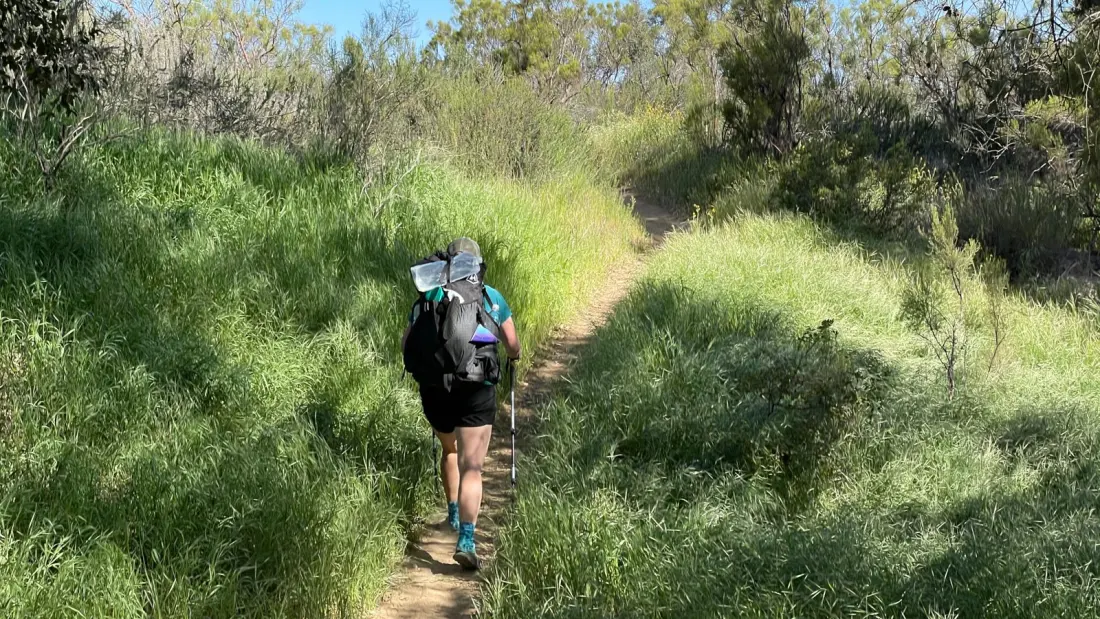
Hunched shoulders, a forward-tilted pelvis, a chin poking out over the trail — if that's your silhouette halfway up a climb with 35 pounds on your back, the problem likely isn't your spine. It's your form. A new skills piece from Backpacker, drawing on Colorado trainer Marc Monroe and chiropractor-physical therapist Steve Brown, lays out how to fix hiking posture before it turns into chronic pain.
The stakes are real. Poor alignment under a heavy pack can lead to neck and back pain, thoracic spine strain, IT band syndrome, hip trouble, even disc issues — enough discomfort to ruin an otherwise good trip. Brown's mental model is a snowman: stack your body's segments directly on top of each other, and the whole structure holds. Let one ball tilt forward and everything below compensates.
The on-trail fix is a stack of simple cues: imagine a string pulling straight up through your knees, hips, spine and head. Elongate the back, tuck the chin, pull shoulders back, keep the pelvis level and the lower back neutral — which usually means quietly squeezing the lower abs, especially with a loaded pack. Look 10 to 15 feet ahead rather than at your boots; your neck will thank you.
If that doesn't solve it, check your pack fit. Monroe calls it the number-one culprit. A properly cinched hipbelt should carry 70 to 80 percent of the load; if it doesn't, the pack slips down, your shoulders round, and you're left hauling the weight with the wrong muscles. Packing matters too: weight all at the bottom pulls you backward, weight stacked too high makes you pitch forward.
Still sore? The missing piece is core stability — not just abs, but traps, rhomboids, rotator cuffs and glutes. Those smaller muscles often lack the endurance to hold good form for hours, so Monroe recommends hitting the gym twice a week for six to eight weeks before a big trip, building from moves like lat pull-downs, reverse flies and dead bugs toward squats, deadlifts and lunges. His suitcase carry is especially clever: if you want to backpack with 35 pounds, train by walking with a 35-pound dumbbell in one hand and bracing against the pull.
For anyone planning a multi-day trek this year, this is the pre-trip homework that pays off most. A few weeks of targeted strength work — plus a hipbelt that actually carries the load — can be the difference between finishing a route grinning and limping off it. It costs nothing, needs no gear beyond basic gym equipment, and works just as well for day hikers as for thru-hikers. Backpacker