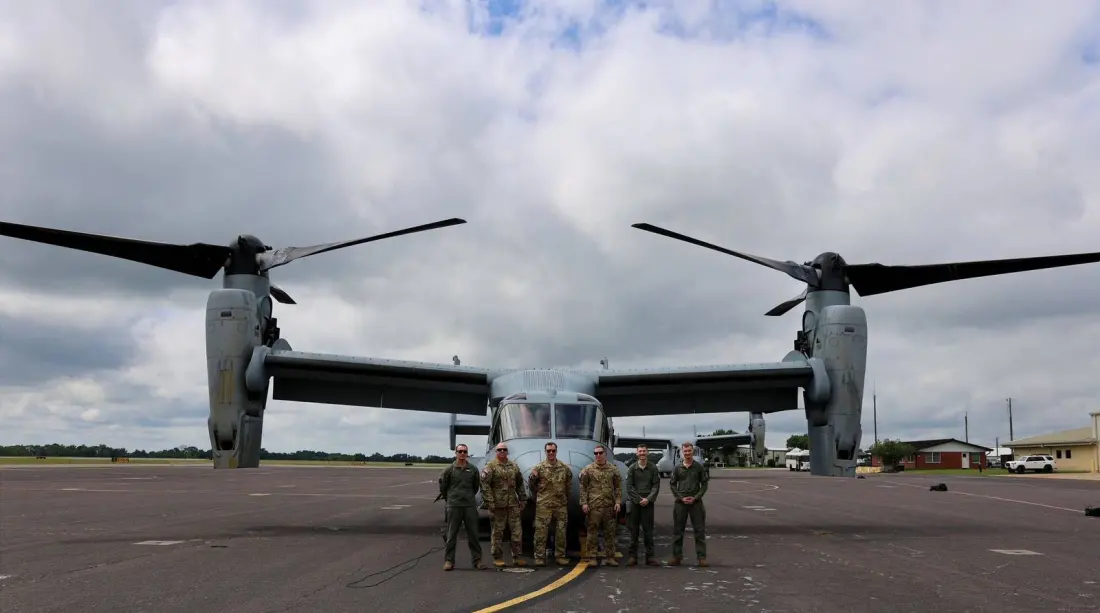
The V-22 Osprey is wrapping up production — the US Air Force took its final CV-22s in 2025, the Marine Corps received its last in July 2026, and only around 11 Navy examples remain to be delivered. But the tiltrotor concept didn't appear out of nowhere, and one of its forgotten pioneers wasn't Bell at all. It was Curtiss-Wright, a WWII aircraft giant whose X-100 and X-19 experimenters quietly fed data into the aircraft the Marines fly today.
The story starts with Bell's XV-3, which first flew in August 1955 and crashed two months later. The second example fared better, completing 110 conversions between helicopter and aeroplane mode between 1958 and 1962 before being damaged in 1966. It survives at the National Museum of the United States Air Force in Dayton, Ohio — same museum, as it happens, where its Curtiss-Wright rival now sits.
Curtiss-Wright had abandoned aircraft manufacturing in 1952 after failing to land meaningful post-war military contracts. Engineers led by propeller-division aerodynamicist Henry Borst saw tiltrotors as a way back in. Their insight: short, wide propeller blades gave a bigger effective disc area without the compressibility problems of long rotor blades, making the design quieter and more aerodynamically efficient than Bell's contemporary efforts. The ungainly-looking X-100, powered by a single Lycoming YF53 turboshaft, began tethered hover tests in April 1959, with test pilot Bill Furlich making the first rolling takeoff in March 1960.
The scaled-up follow-up, redesignated X-19 under a tri-service agreement, first flew in November 1963. It completed 50 flights, reaching 454 mph and 25,600 feet, but never managed the full hover-to-cruise transition. After a gearbox failure and pilot error destroyed one prototype in 1965 — both pilots ejected safely — the Air Force lost interest and cancelled the programme. It was Curtiss-Wright's final aircraft. The survivor went to the Ohio museum in 2007.
Why did tiltrotors stall for two decades? Simply put, helicopters were good enough. That changed after the failed 1979-80 Iran hostage rescue, when the US bolted rockets onto a C-130 Hercules (Operation Credible Sport) trying to build an aircraft that could land in a stadium and fly to Tehran and back. The rocket Hercules crashed in testing, and the military dusted off tiltrotor designs instead — leading to the Bell XV-15 demonstrator of 1977 and, ultimately, the Osprey in 1989.
The legacy is very much alive. The Army's incoming MV-75 Cheyenne II will partly replace the Black Hawk fleet, promising missions "twice as far, twice as fast," and commercial eVTOL air taxis from Joby and Archer borrow the same tilt-rotor logic. China even flew a prototype tiltrotor in 2025.
For travellers, the takeaway is a good one for an aviation-themed detour: the National Museum of the United States Air Force in Dayton, Ohio displays both the Bell XV-3 and the Curtiss-Wright X-19 — the alpha and omega of this odd, brilliant chapter in vertical flight — and admission is free.