The Boeing 777-300ER has been the workhorse of long-haul flying for over a decade, but its passenger production has ended. Its successor, the 777X, has slipped repeatedly — once due in 2020, now not expected in commercial service until 2027 — yet airlines keep ordering it in large numbers. The reason comes down to the numbers: more seats, less fuel burn, and in some versions, seriously longer range.
Boeing's specifications show the smaller 777-8 will manage 8,745 nautical miles (16,190 km) with 395 seats in a two-class layout. The larger 777-9 tops out at 7,285 NM (13,500 km) but carries 426 passengers. Oddly, the old 777-300ER still beats the 777-9 on paper range by about 85 NM — but the 779 carries 34 more people. The 777-8, meanwhile, flies roughly 1,375 NM further than its predecessor while seating three more. Why does the bigger plane fly shorter? Fuel lives in the wings, and both 777X variants share the same wing — so the heavier 777-9 pays a range penalty for its extra fuselage.
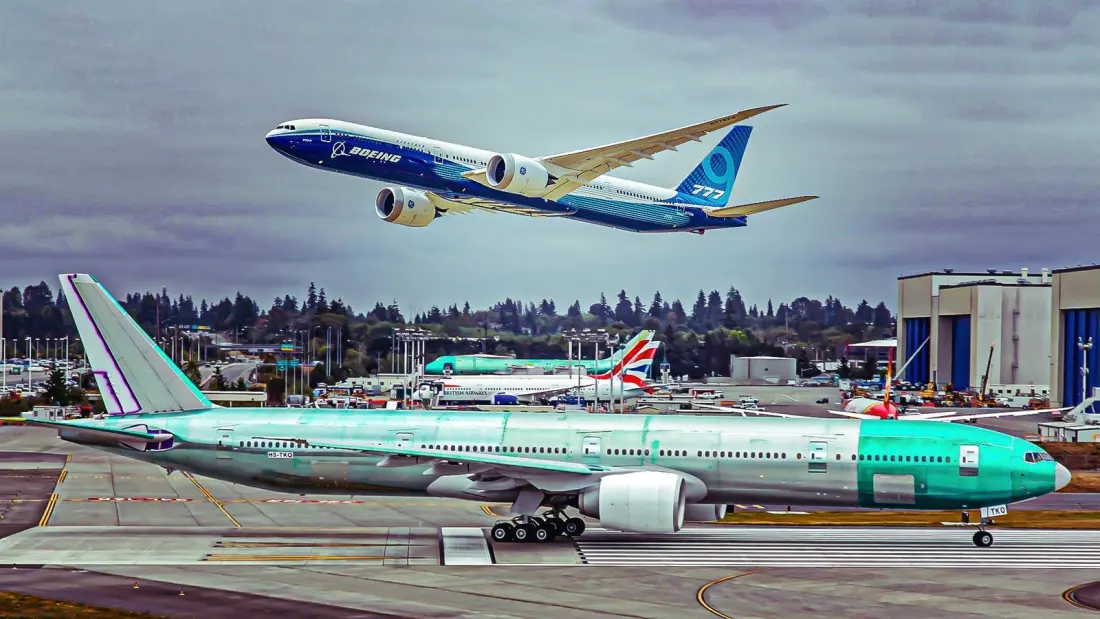
Two bits of engineering make this possible. First, the 777X has folding wingtips — a world first — giving it a 235-foot wingspan in flight for efficiency, but shrinking to 777-300ER dimensions on the ground so it can use existing airport gates. Second, GE Aerospace's GE9X engines, the largest commercial jet engines ever built (their diameter exceeds a 737's fuselage), deliver roughly 10% better fuel efficiency than the older GE90. Boeing claims the 777-9 overall burns 20% less fuel and has a 40% smaller noise footprint than the plane it replaces.
There's a freighter too: the 777-8F, launched in 2022, hauls 112 tonnes of payload — 10 more than the current 777F — though it sacrifices 560 NM of range to do it. And at Dubai Airshow 2025, Emirates ordered 65 more 777Xs and pushed Boeing to study a stretched 777-10. With A380 production ended in 2021, Emirates wants a high-capacity flagship for its Dubai hub-and-spoke model, and it's nudging the industry the same way it once pushed for bigger jets. Airbus, for its part, has floated a stretched A350-2000 to rival it.
For travellers, the practical upshot: once the 777X enters service from 2027, expect more non-stop ultra-long-haul routes — think Singapore to New York-class distances on a plane with a proper economy cabin — plus quieter takeoffs around airports and, eventually, lower emissions per seat. Which aircraft you're on will increasingly matter to how comfortable that 15-hour flight feels.