Skip London for a few days and head southwest: Somerset packs medieval streets, moody marshland, seaside harbours and one very famous wet festival site into a single, gently rolling county.
The appeal is the sheer range. Wells, tucked into the Mendip Hills, may be the pick of the bunch for architecture lovers — its 12th-century Gothic cathedral holds roughly 300 medieval statues, the market retains two original medieval gateways, and Vicars Close is possibly England's only surviving complete medieval street. Add the Bishop's Palace and Gardens and you have a genuinely walkable day out.
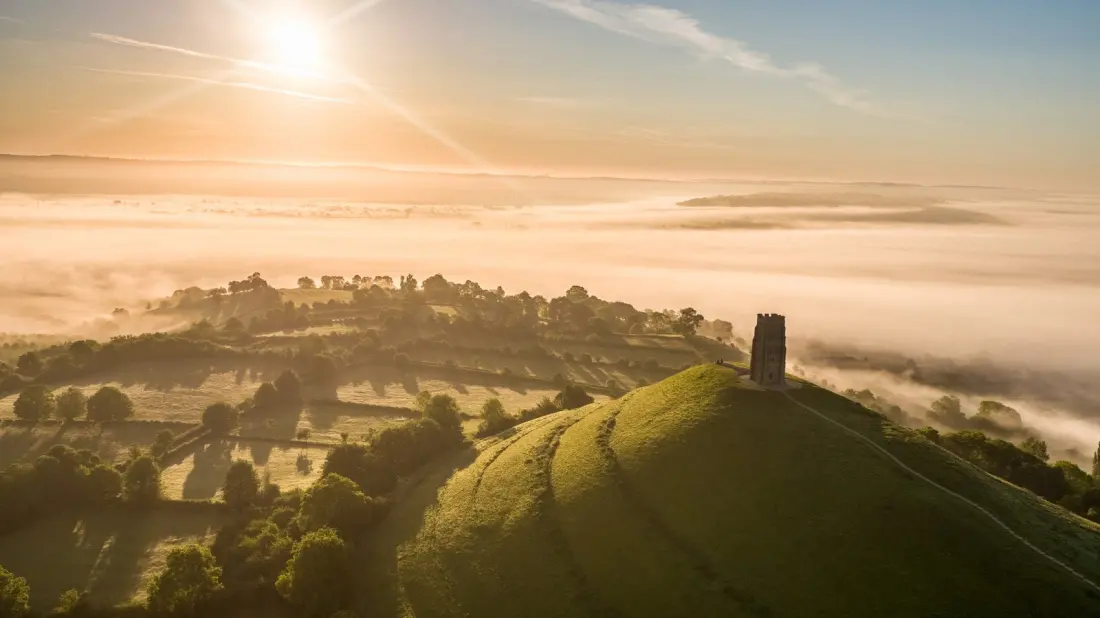
Glastonbury trades Georgian polish for myth. The town sits beside the Avalon Marshes, a rare wetland tangled in Arthurian legend, and its landmarks lean into it: the ruined abbey, Chalice Well, White Spring and Wearyall Hill, all under the gaze of the 14th-century Glastonbury Tor topped by the remains of St Michael's Church. (Small print: the world-famous Glastonbury Festival actually happens over in Pilton.)
Bath needs little introduction — a UNESCO-recognised Roman spa complex that's among Europe's best preserved, plus Royal Crescent, The Circus and a heavy Jane Austen connection. For something quieter, Somerton was once the capital of the Anglo-Saxon kingdom of Wessex and now sits on a hill wrapped in photogenic stone buildings, with a 13th-century church and a 17th-century Buttercross in the market square that gets illuminated after dark.
Further out, Bruton on the River Brue mixes 12th-century abbey remains and a 16th-century dovecote with a surprisingly chic gallery, shopping and dining scene. Minehead, Somerset's main seaside town on the Bristol Channel, pairs Cleeve Abbey and Dunster Castle with steam-hauled rides on the West Somerset Railway — and there are said to be submerged ruins just offshore. Bridgwater, on the River Parrett, throws the famous Guy Fawkes Carnival every November, while Castle Cary keeps an 18th-century lock-up (the Round House) and a 19th-century Market House. Yeovil, a Roman-era route town, lost much of its old centre to fires but keeps the striking 14th-century Church of St John the Baptist and nearby Ham Hill Country Park, an Iron Age hillfort with sweeping views. Taunton, the county's practical base, balances good shopping and dining with Taunton Castle, now home to the Museum of Somerset.
Why it matters: this is England's history without the coach parties — a county where you can swim between Gothic cathedrals, hillforts, coast and spa cities, all within short drives. It suits slow travellers, walkers and anyone who wants market squares rather than megastores. Getting in is easy: Bristol Airport serves the main towns, and Great Western Railway trains run direct from London stations into Somerset year-round.